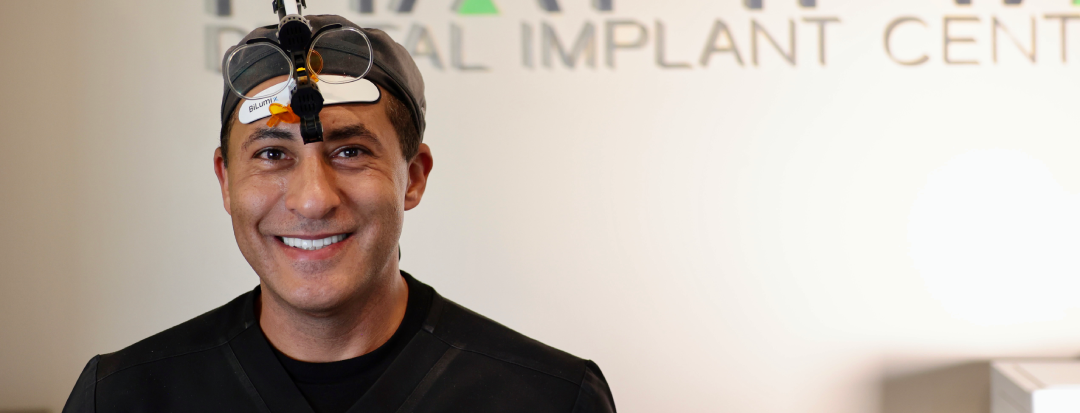
There’s a certain type of entrepreneur whose story stretches across borders and generations. Someone who builds not only a business, but a philosophy—Dr Raouf Hanna is one of them. Born and raised in Cairo, trained in the United States, and known across Houston for his surgical mastery in implant dentistry, his journey reads like a study in discipline, intention, and the quiet force of long-term thinking.
By the time he sold Hanna Dental, a practice he built from scratch over twenty-five years, he had already designed a life that most founders spend their entire careers chasing: financial independence, multigenerational stability, and complete autonomy over his time. But what makes his story especially compelling is the way it folds back into community. From supporting limb-replacement programmes in Texas to his work with Parallel School, an educational initiative serving children in Cairo, Dr Hanna’s success has always travelled in two directions—upward and outward.
Bryan Welker sat down with Dr Hanna to gain insight into the mindset behind it all: the discipline to live below your means, the courage to invest when others panic, the clarity to ignore distractions, and the purpose to build beyond yourself.
The Good Business Journal: You’ve just come through the classic entrepreneurial arc: building a business from nothing, reaching the top of your profession, and ultimately selling at the height of your success. It’s a big question to distil into one moment, but can you reflect on the journey that brought you here?
Dr Hanna:
I wish I could tell you there was a perfect step-by-step plan: do one, two, three, and it all works out. But for me, it was mostly about mindset. I always had a clear end goal. I came from a supportive family that helped me get my education, but financially, I started from zero. So I set two goals: become a millionaire by 40, and retire by 50.
I ended up becoming a millionaire at 32, and I could have retired at 45, but I stayed the course. Two weeks ago, I turned 50, and I consider myself retired now—but let me qualify that. Retirement, to me, means I don’t have to show up anywhere unless I want to. I can choose my time, choose my work, and choose who I spend my days with.
It doesn’t mean I stop achieving things. Some projects will make money, others won’t. Some are for-profit, some are nonprofit. But I’ve created multigenerational wealth for my kids and their kids. And most importantly, I get to live life fully on my own terms.
Bryan: How does it feel to know you’ve done that?
Dr Hanna:
It feels great, though it probably hasn’t fully sunk in. In medicine, especially, people often work until they die, or retire and then decline quickly. My definition of retirement is different. I’m not going to sit around doing nothing. I’m simply transitioning from one form of work to another.
Now it’s about passive income, protecting my health, protecting my mental health, and creating a quality of life that’s actually lived. A big part of our purpose is to leave the world better than we found it.
Bryan: If you had one piece of advice for a young business person anywhere in the world, what would it be?
Dr Hanna:
Don’t expect an easy road. And don’t make the mistake of thinking early success means you’ve made it forever. I see so many young entrepreneurs splurge too quickly — upgrading their lifestyle for image rather than for joy.
I have a car that costs around $200,000. I could buy five of them. But why? One is enough. I enjoy it for what it is—not for how it makes me look.
Bryan: Discipline seems to be a running theme. Where does that come from?
Dr Hanna:
You need discipline to get anywhere. You need motivation, and you need a clear goal at the end. The journey is just the steps. Don’t confuse the road for the destination.
If you get distracted along the way—by material things, alcohol, drugs—you risk losing everything. I’ve seen it destroy entrepreneurs. We’ve had tragic deaths due to overdoses here in the Houston medical community.
Bryan: In your view, what’s the most important characteristic an entrepreneur should have?
Dr Hanna:
People skills. And a good understanding of risk. You must have an appetite for risk, but it has to be the right amount. I’ve invested in startups and new markets, but always after careful study. I’ve lost some and won some, but that’s part of the journey. Without risk, you can’t grow.
Bryan: Was your career always steady growth, or were there moments where you felt you might not make it?
Dr Hanna:
I never believed I wouldn’t make it, but I did experience pressure. In 2008, I opened a new practice and was building a $2.5 million real estate project. I had $8–9 million in loans and every asset tied up. My stock portfolio was down 35–40% in the financial crisis.

Cash flow was tight. I had no safety buffer. But I never missed a payment. And looking back, that period created some of the best opportunities of my life. I bought stocks then—Apple, Facebook, Google, Bank of America—at what now looks like ridiculous prices. Some of those gained 900% because I held onto them.
Bryan: Recognising opportunity in chaos—that’s a core entrepreneurial instinct.
Dr Hanna:
Exactly. Especially in the stock market. When everyone runs out, you run in. When everyone runs in, you run out. Most people act from emotion—fear of losing money. But if you need that money to live, you shouldn’t be in the stock market. Your emergency fund should be untouched.
When I invested back then, I told myself: I won’t need this money for twenty years. That’s discipline. You don’t sell. You hold. Or you buy more.
Bryan: So what’s next for you?
Dr Hanna:
I’m investing in a tech startup in the oil and gas sector, creating digital tools for safety and predictive analysis. Our first prototype is being tested now.
And my nonprofit work continues. I’m involved with an organisation called Hope, working on a project called Parallel School—this year is our tenth anniversary. We’re focused on providing education to kids in Africa who don’t have access to it. Last summer, my children and I spent time in Cairo giving out computers and teaching English and basic computer skills.
We also support a programme in College Station at A&M that provides artificial limbs for children who’ve lost them due to cancer, surgery, or accidents. That work is deeply meaningful.
There are entrepreneurs who chase success, and then there are entrepreneurs who design a life. Dr Raouf Hanna belongs firmly in the latter category. His story carries the unmistakable rhythm of long-term thinking: clear goals, disciplined restraint, strategic risk, and a deep belief that prosperity means little unless it’s shared. From the operating room to the stock market to classrooms in Cairo, his work is a reminder that good business is, at its core, a practice in purpose—a choice to build beyond yourself.
Every week, The GBJ editorial team sits down with some of South Africa’s best. With a tenacity and spirit that can create success out of nothing more than a glimmer of hope, we believe South African businesses deserve a platform to tell their stories.
Born from WDR Aspen, The GBJ wants to ask you: how are you telling your story? Reach out and let us help you with your voice.