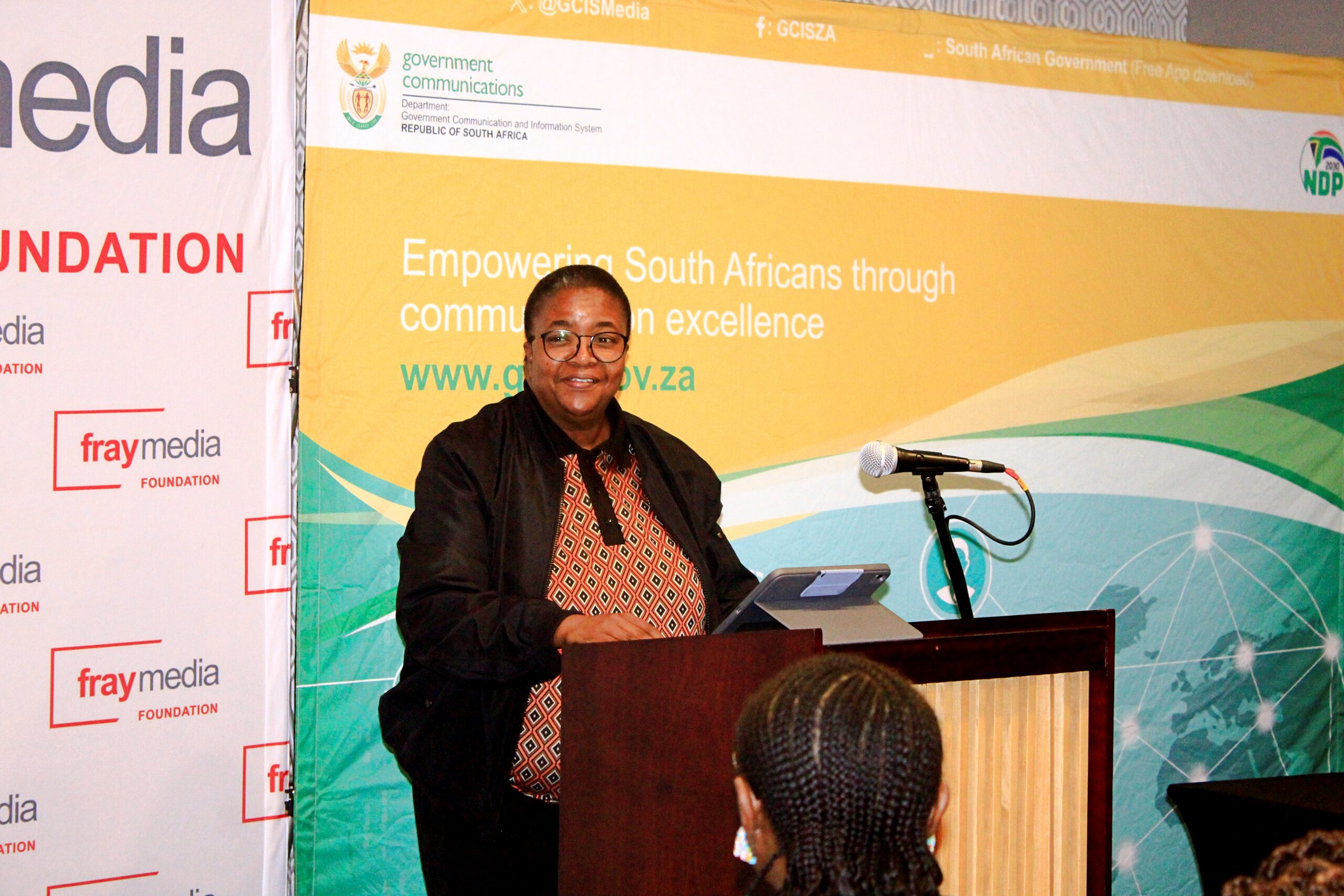

South Africa does not lack young talent. It lacks the systems that allow that talent to be seen, supported, and absorbed into earning pathways.
Kasthuri Soni has spent 15 years inside that problem at Harambee Youth Employment Accelerator (Harambee), where she now serves as Chief Executive Officer. A chartered accountant by training, she built her early career at Deloitte, led Soul City as its CEO, and later joined Harambee as it was being built into a standalone entity. That combination of commercial rigour, executive experience and long exposure to the realities of youth exclusion gives her unusual authority on one of South Africa’s most urgent challenges.
Stefan le Roux sat down with Kasthuri to discuss the structural barriers keeping young South Africans out of work, the systems Harambee has built to reduce that friction, and why she believes the country now has a credible path to changing the trajectory of youth unemployment.
The Good Business Journal: What did your childhood and background teach you about work, confidence and opportunity?
Kasthuri:
I grew up in Durban in a working-class family, and I was grounded very early in family values, discipline, and the belief that if you put in effort and have a strong work ethic, you can achieve success.
My dad was a huge influence in my life. He used to say, “People can steal your money, but they can never steal your education.” He always encouraged me to study further and believed in me unconditionally. He was an artisan, but he intuitively understood the value of education, practical skills and work exposure.
Even as a child, he instilled this in me, having me work part-time in my uncle’s business when I was young. We used to joke that it probably cost him more to buy me lunch than I was earning, but he knew the real value wasn’t the money; it was the experience and the skills I was gaining.
Looking back, one of the greatest gifts he gave me was confidence. In my work today, especially with young people, I see how profoundly a person’s life is shaped when they grow up believing they are worthy, valued, and capable.
My dad built a warrior in me, instilling work ethic, discipline and resilience that have stayed with me. But his greatest lesson went beyond hard work. It was to back myself with conviction, and then to earn that credibility through relentless effort. He taught me that belief without action is hollow, and it is only through hard work that belief becomes real.
Stefan: You trained as a chartered accountant and spent years at Deloitte. How did that path lead you into social impact and eventually to Harambee?
Kasthuri:
When I was younger, I wanted to be a teacher. But once I learned about the accounting profession, it resonated with me, and chartered accountancy gave me a very clear path.
I qualified through Deloitte, and that training gave me rigour, discipline, professionalism and the ability to think laterally. But numbers and balance sheets were never what energised me most. I was driven by a desire to work with people, drive meaningful change, and be of service.
My first pivot came through Soul City, which was a client of mine while I was at Deloitte. Although I was on a path to partnership at Deloitte, I found myself drawn to something more purposeful. I wanted to apply my skills to create lasting impact, not just commercial success.
So, I joined Soul City as Head of Finance. Then, when the founding CEO moved on, he encouraged me to apply for the CEO role. I said, “I’m not a medical doctor. I’m not a public health specialist.” But he said that the business was at a stage that needed my expertise and experience.
That was a defining shift in my career, expanding my remit from finance into enterprise-wide executive leadership with responsibility for the entire organisation.
After that, I took a short sabbatical and then joined Yellowwoods while Harambee was being incubated as a separate entity. I started as CFO and later transitioned into the CEO role at Harambee.
Stefan: There is still a narrative that unemployed young people simply need to try harder. What does that narrative miss?
Kasthuri:
It misses just how complex and structural this problem is. We would love there to be a silver bullet solution, but there isn’t one.
South Africa has 9 million young people who are not in employment, education or training. Every year, more than a million more enter the labour market, and roughly two-thirds of them will end up in that category if we do not intervene.
But the challenge is not only that the economy is not creating enough jobs. It is also that young people face a myriad of barriers just trying to access opportunity. Transport is expensive. Mobile data is expensive. A young work-seeker may be asking: Do I have money to search for jobs? Do I have someone to look after my child if I need to go to an interview? Do I have appropriate clothing?
We have also learned that young people’s pathways in the economy are not linear. They zigzag, moving in and out of opportunity. So, when a young person falls out of one role or programme, the question becomes: can we illuminate the next best opportunity for them, and can we make it frictionless to get there?
At the heart of our work is the fundamental belief that talent is everywhere, but opportunity isn’t. That is why the narrative that young people are lazy or entitled is such an incomplete one. The barriers are real, the systems are fragmented, and if we want better outcomes, we have to solve for systemic issues.
Stefan: What is SA Youth, and how does it help organise the system around the young person instead of forcing them to navigate it alone?
Kasthuri:
SA Youth is a technology-enabled platform that Harambee built to give young people visibility and access to opportunities across the economy. It was intentionally designed to meet young people where they are. It is a multi-channel platform with a mobi site, a toll-free contact centre, social media channels and in-person support. The platform is also zero-rated, which means young people do not need to spend money on mobile data to access it.
That matters because design determines outcomes. If you know transport is expensive, that childcare responsibilities are real, and that some people cannot easily leave home, then you have to build something that reduces those barriers from the start.
From a work-seeker perspective, sayouth.mobi gives young people line of sight to opportunities and helps them on their journey through the labour market. If a young person completes a short-term placement, the objective is to pathway them to the next opportunity to keep them productively engaged and building an employability profile over time. We have now supported a network of over 4.6 million youth.
Importantly, SA Youth also gives employers and opportunity holders access to a talent pool across the country at reach and scale. Capable young South Africans with incredible potential are made visible to the economy.
Stefan: What do employers often fail to see when they rely too heavily on traditional CVs, matric marks and prior work experience?
Kasthuri:
What employers often fail to see is that a young person might not have worked in a formal environment before, but they may have volunteered at a church or been selling cosmetics as a side hustle. That tells you something about their agency, resilience and initiative. That’s why we have reimagined how talent is identified by building alternative, inclusive matching signals.
We have a learning potential screener that measures a young person’s problem-solving capability. We have a behavioural screener that shows grit and resilience. And we have built an SA Youth CV that shows an employer a young person’s paid and unpaid, formal and informal work experience, so they get a more holistic view and a clearer signal of capability and potential.
We also did some experiments, and they showed that when we applied these screeners, it opened up a talent pool of about 50% more young people who could be a match for a job but would be overlooked if an employer had used only traditional filters.
And even on English, instead of just reading a young person’s English mark on a CV, we allow them to upload a voice note so you can hear their spoken English.
That is really what inclusive hiring looks like in practice. Young people are not a bet. They actually have talent. But employers have to be willing to judge that talent differently beyond traditional CV matching.
Stefan: Where do you see the greatest potential to create youth jobs at scale?
Kasthuri:
Global Business Services (GBS), which is in the contact-centre industry, is one example of a sector that has high youth labour-absorbing capacity and gives young people the ability to move in their careers.
Harambee has spent the past decade partnering with this sector because it creates significant opportunities for young people, particularly young women and young people with disabilities, equipping them with skills that are transferable across industries.
Obviously, there is concern about the impact of AI and the extent to which jobs will be replaced. In response, the sector is driving a strategy to upskill young people in AI. But interestingly, what it is lending itself to is that the sector needs to elevate to servicing more complex work. And one of the qualities that international customers consistently value in South Africans is our empathy.
Despite all of those concerns, in 2025 the sector created more than 20,000 net new youth jobs. These are jobs that did not exist before. This is an example of where Harambee has played an orchestration role, bringing together business, government, and civil society. It has been about skilling, but it has also been about promoting South Africa as an attractive destination, backing the industry body, and influencing the incentive so that at least 30% of those new jobs go to young people who have not been employed before.

Digital is another major area of opportunity, but there, the challenge is a demand-supply mismatch. Employers were saying to us that yes, somebody might have theoretical training, but they do not have the practical experience. That is why Harambee helped co-incubate Collective_ X, which is scaling an outcomes-based model that gives young people work-integrated learning experience.
Stefan: You make a distinction between entrepreneurship and self-employment. Why does that distinction matter?
Kasthuri:
Not every young person needs to become a thriving entrepreneur who hires more people. Of course, we need those. But we also need people to be able to earn income for themselves that is less precarious and gives them a decent livelihood.
Even if our economy grew and we solved all of our binding constraints, we are still not going to have enough formal jobs. So, self-employment is critical to enabling more young people to participate in the economy.
Typically, most young people might be doing some side hustle, but they are doing it while waiting for a job. And the sentiment of parents is often, “Why are you doing that? Go and find a real job.” So, we have a big task ahead of us in trying to shift that behaviour and mindset, not only among young people, but in the country more broadly.
One of the ways to do that is through peers. When I see my peer earning an income by driving a scooter or earning income by braiding hair and changing their life, that is what gives me the motivation and incentive to consider that path.
But then we also have to provide the scaffolding support that is needed: access to market, access to finance, access to skills, and what is actually going to help them earn a more sustainable income.
Stefan: What is your outlook for the remainder of the decade?
Kasthuri:
For the first time, we have a pathway to moving the dial on this national urgent issue. Informed by 15 years of data, evidence and learning, we undertook some economic modelling with the Presidency. What it shows is that if we have economic growth and we pull the right levers together as a country, we can reduce youth unemployment by 20% by 2030. That translates into roughly 1.8 million more young people in earning pathways.
There are four major levers. The first is that the private sector must hire and retain young people with intention. The second is that we need net new jobs in growth sectors. The third is that we need more young people in self-employment. And the fourth is Public Employment Programmes (PEPs), which act as a shock absorber when the economy is not growing at the rate it needs to.
The cross-cutting work is pathway management and demand-led skilling. What is clear is that no single sector can solve this challenge alone. The critical enabler of transformative change is strong partnerships between business, government and civil society around this shared agenda.
What excites me is that we have an emerging, credible programme of action to change the trajectory of youth unemployment.
Stefan: What advice would you give to young people trying to find a way into the economy?
Kasthuri:
Firstly, register on sayouth.mobi. And then I would say have a growth mindset. Take every opportunity to learn and grow your skills. Keep moving, even if it is volunteer work.
The value of formal and informal experience, and what that does for your ability to be engaged and participate in the economy, is just phenomenal.
Stefan: What makes you optimistic?
Kasthuri:
The young people themselves. Every time you engage with them, it just fuels you. We often talk about young people as if they are disengaged, but that is not what we see. An example is a teacher assistant programme in which there were just over 200,000 opportunities available, and nearly 2 million young people applied. That tells you very clearly that young people want opportunity. They want to be economically active.
And then secondly, I do have the gift of working with the most exceptional leaders. Having a group of highly talented, committed people who are united by a shared mission at a time when there is an emerging roadmap to reduce youth unemployment fills me with hope and optimism.
What stays with you at the end of the conversation is the same idea that shaped Soni early on: people grow when someone helps them recognise their own value. Her father taught her that education was something nobody could take away, and that belief became a source of confidence, discipline and direction.
In many ways, the work she now leads is an attempt to extend that logic at scale. The young people are there. The willingness is there. And, increasingly, so is the roadmap. The task now is to keep building pathways worthy of that potential.