Bryan:
From an early age, Kelly Hoffman developed an uncommon ability to adapt, read her environment, and move decisively. Change was the only constant, and it sharpened her resilience, teaching her how to create momentum where others might stall. Over time, that momentum became a strength—one she learned to harness deliberately, using action and structure as meaningful tools to create stability on her own terms.
That ability would later find its clearest expression in entrepreneurship. By building systems and companies, Hoffman translated adaptability into control, eventually culminating in the sale of a South Africa–based software company to a Seattle firm. That exit marked both an ending and a turning point—creating the space for her to step back, reassess what mattered, and begin building again from a place of curiosity rather than necessity.
Bryan Welker and Stefan le Roux sat down with Kelly Hoffman to trace that journey—from a childhood shaped by constant change, through the pursuit of stability via entrepreneurship and a successful tech exit, to the moment where stepping back created space for curiosity, creativity, and the unknown.
The Good Business Journal: Kelly, let’s start at the beginning. Where did you grow up?
Kelly:
I was born in Johannesburg and have lived in a few different places around South Africa, but I am very much a Joburger at heart. I love the energy of the city. I often say my love language is momentum, and Johannesburg has it in abundance.
I have been fortunate to travel extensively, and people often ask me what the best country I have been to is. My answer is always South Africa, and I mean that without hesitation.
Stefan: What did your school career look like?
Kelly:
Very unconventional and unstable. I grew up in a single-mother household and went to more than 18 different schools. There was no continuity, no long stretch of familiarity. I was constantly the new girl, always having to start over.
Because of that, I didn’t really have the space to build long-term friendships in the way others did. You are often arriving after the friend groups have already formed and the dynamics are set. You either learn very quickly how to read a room and adapt, or you find yourself on the outside.
Bryan: I moved schools constantly growing up—different states, different years—and I remember how disorienting that was. You walk into a cafeteria full of strangers, no friend groups, no context, and you either figure out how to read the room and adapt, or you stay on the outside. Over time, that became a kind of superpower for me. Do you see it the same way?
Kelly:
Absolutely. Moving around that much forces you to adapt.
At the time, it felt unfair and chaotic. Looking back now, I can see how much it shaped me. It forced independence early and gave me the ability to adjust to new environments, new people, and new expectations very quickly.
I don’t share that looking for sympathy. I worked through the shame a long time ago and learned to see it as a tool rather than a deficit. There isn’t a neat, linear story there, but that instability became a foundation for how I learned to navigate the world.
I genuinely believe you could put me in the Sahara Desert and I would survive.
Bryan: What advice would you give to someone finishing school who grew up with similar instability?
Kelly:
Anything is possible. That’s the truth.
At 18, belief is hard because you don’t yet know what belief even looks like. But grit matters. The people you surround yourself with matter. You don’t need wealth, status, or impressive networks, just people with integrity.
Learn to ask for help and say when you’re not okay, even when it’s messy. And trust your intuition. It is a powerful tool. Sometimes belief comes after action, not before, but that doesn’t make it any less real.
Stefan: Can you walk us through your professional path—how you found your way into building and eventually selling a software business?
Kelly:
Vocalysd was born during lockdown, a period of enforced pause that sparked a deeper curiosity in me. The idea came from exploration rather than strategy. I became fascinated by how people communicate, not only through words, but through pauses, hesitation, and shifts in tone.
What began as a personal interest quickly became a professional one: how does the power of voice influence the growth or decline of a business, and how can that be measured and managed at scale in a way that genuinely adds value? That question led me to build AI-driven software that analysed voice data in call centres and translated those patterns into insights businesses could actually use.
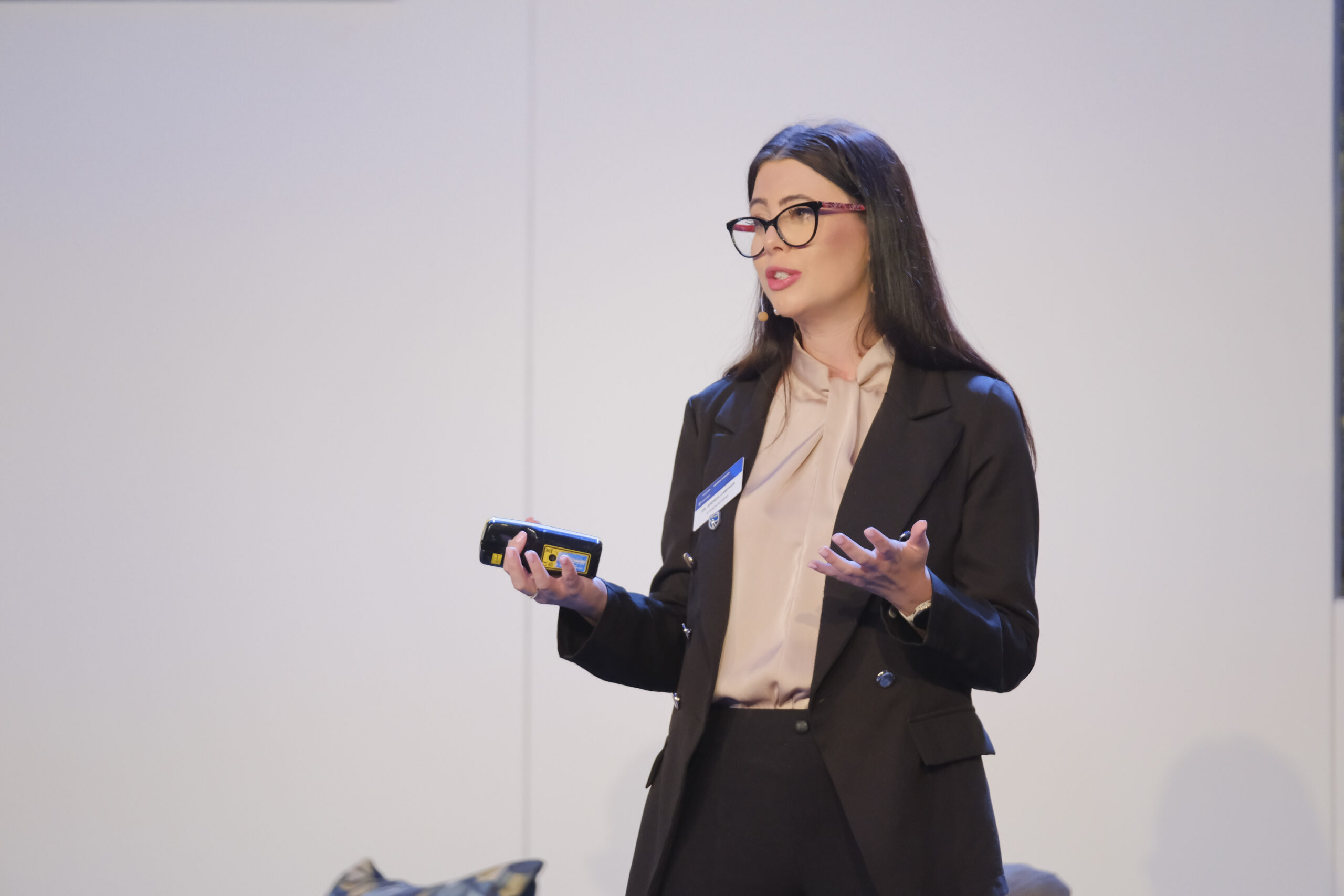
I am not a coder, and I never pretended to be. My role was bringing the right people together and asking the right questions. The journey was far from easy. There were valuable lessons, and there were hard ones. I made early mistakes: wrong hires, the wrong technology choices, and placing trust where it didn’t belong. At one point, money was even stolen from the business.
For long stretches, it felt like I was carrying far more than I fully understood. In truth, I was in over my head. But I was already too invested, too passionate, and perhaps too stubborn to walk away. I pushed forward, determined to bring the vision to life and build something with real impact. There were many moments where I almost walked away.
Despite this, the product evolved. It shifted, pivoted, and improved through multiple iterations. We learned quickly, listened closely, and over time built something that worked. That journey ultimately culminated in the full acquisition of Vocalysd by a Seattle-based firm.
Stefan: How did your time with Vocalysd reach its conclusion, and what did that moment of selling look like for you?
Kelly:
It was incredibly difficult. There were moments where I genuinely considered closing the business altogether. I was exhausted, and my confidence was completely lost. I had been self-funding it, pushing through things I didn’t fully understand, and carrying far more than I should have.
Through what I can only describe as a series of small miracles, I found myself on a flight to Seattle, despite feeling completely depleted and holding very little belief that an acquisition was even possible. Through a close friend’s network, I was introduced to two potential buyers. One looked right on paper but didn’t feel right. The other was not the obvious fit at all, yet my instinct told me otherwise.
That second company went on to acquire Vocalysd. It remains one of the best decisions I have made. They are an exceptional company to work with and fundamentally shifted the trajectory of my life. The sale of Vocalysd gave me the freedom to fail, and the safety to try again.
By the time we were finalising the transaction, I had taken the business as far as I could on my own. Getting it across the line was not something I would have been able to do alone. My wife Monique was an integral part of that chapter. Her technical depth, focus, and ability to put her head down and execute were pivotal in closing the deal. When I was depleted and questioning everything, she stepped in where it mattered.
The freedom to fail did not come from the transaction alone; it came from having the right partner beside me. The sale gave me the safety to try again, and she has since taken Vocalysd forward and grown it into something I would not have been able to build myself. We’re a strong team.
Bryan: Knowing when to step aside is a skill executives are often reluctant to onboard. How did you deal with it?
Kelly:
Knowing when to quit is just as important as knowing when to push. There is a fine balance, and it requires setting ego aside and being honest with yourself. We tend to romanticise perseverance, but sometimes holding on is the easier option, even when it is doing more harm than good.
I also learned that if I am broken, the business is broken. There was a direct correlation. Admitting that I had taken the company as far as I could was difficult, but it allowed the business to move forward and ultimately be sold. Success looks different to everyone. For me, choosing sanity over ego wasn’t a defeat – it was the decision that gave me the freedom, clarity, and peace to build again from a better place.
Stefan: What has life looked like for you since selling Vocalysd?
Kelly:
Not long after selling Vocalysd, I lost my mom, and that changed everything for me. I took some time to pause and recalibrate
It was the most horrific and hardest thing I’ve ever been through, but strangely, it also became one of the most meaningful times of my life. I stopped trying to force what was next and allowed myself to sit in the unknown.

I started asking different questions: how do I want to feel, who do I want to work with, how do I want to show up in the world? That sabbatical gave me the clarity and freedom to rebuild from instinct instead of survival.
Stefan: And now you’re on the verge of launching a beverage company, quite a drastic shift from tech. How did that pivot come about?
Kelly:
If you had asked me two years ago what my “next” would be, I would never have said a beverage brand. It is one of the most unfamiliar territories I could have chosen. After selling my software business, I was intentional about not forcing myself into the next chapter. I have always been drawn to building businesses, but I reached a point where clarity could not be manufactured. It had to arrive naturally.
I realised that much of my life had been spent operating within the “known”, understanding the rules, limits, and expectations because they felt safe and predictable. After everything that had happened, I allowed myself to explore the opposite. The unknown shifted from something to fear into a space for creativity and renewed passion.
I came across an idea while spending time in the States, and it stayed with me. I could not shake it, and that persistence told me it mattered. What drew me in was not only the product itself, but the opportunity to build something physical and sustainable, something that created moments of connection rather than chasing scale for its own sake.
It sat completely outside my experience and comfort zone, FMCG, beverages, and a physical product, but that was part of the appeal. Not knowing became a strength again. It allowed me to question everything, approach the process with curiosity, and be deliberate about what went into it and what it stood for. I have been building on my own terms, guided by instinct, curiosity, and grit.
Stefan: I don’t want to force you into letting the cat out of the bag, but can you give a high-level description of the product?
Kelly:
Okay, let me spill it and hope this gets published after the public launch.
hopnøsis is a non-alcoholic, sugar-free, calorie-free sparkling water made with hops and functional ingredients including ashwagandha, L-theanine, and vitamin C.
The hops drive the flavour and aroma. The functional ingredients are there to support how you feel, not change who you are or override the moment. The formulation is intentional, but the experience is simple and easy to enjoy.
A first of its kind on this continent, proudly homegrown and self-funded.
Bryan: What has changed for you going from tech to working on something more physical and hands-on?
Kelly:
Tech lives very much in the fast lane, with constant pressure to scale, optimise, and move quickly. This shift has forced me to slow down and be more present. I have been deliberate about building something meaningful and sustainable, something people can experience and connect with on a human level. It matters to me that it feels good to hold, good to share, and aligned with my values and those of the people it serves.
For me, it comes down to no compromise. No compromise on integrity, on what goes into it, or on how it shows up in the world. Impact does not need to be loud to be real. It can be quiet, honest, and deeply meaningful.
Stefan: To close off Kelly, if you were speaking to a foreign investor concerned about South Africa, what would you tell them?
Kelly:
Resilience. We do a lot with very little. We make a plan, we adapt, and we keep moving. There is a depth of resourcefulness here that is easy to underestimate, and once you experience it, you realise why South Africans continue to build, even when the odds are not in our favour.
Bryan:
Kelly Hoffman’s story isn’t about reinvention for its own sake. It’s about learning when control stops serving you—and having the courage to trust what comes next. In momentum, in flow, and in choosing alignment over fear, she offers a reminder that sometimes the most powerful move is allowing yourself to begin again.
Every week, The GBJ editorial team sits down with some of South Africa’s best. With a tenacity and spirit that can create success out of nothing more than a glimmer of hope, we believe South African businesses deserve a platform to tell their stories.
Born from WDR Aspen, The GBJ wants to ask you: how are you telling your story? Reach out and let us help you with your voice.