Bryan:
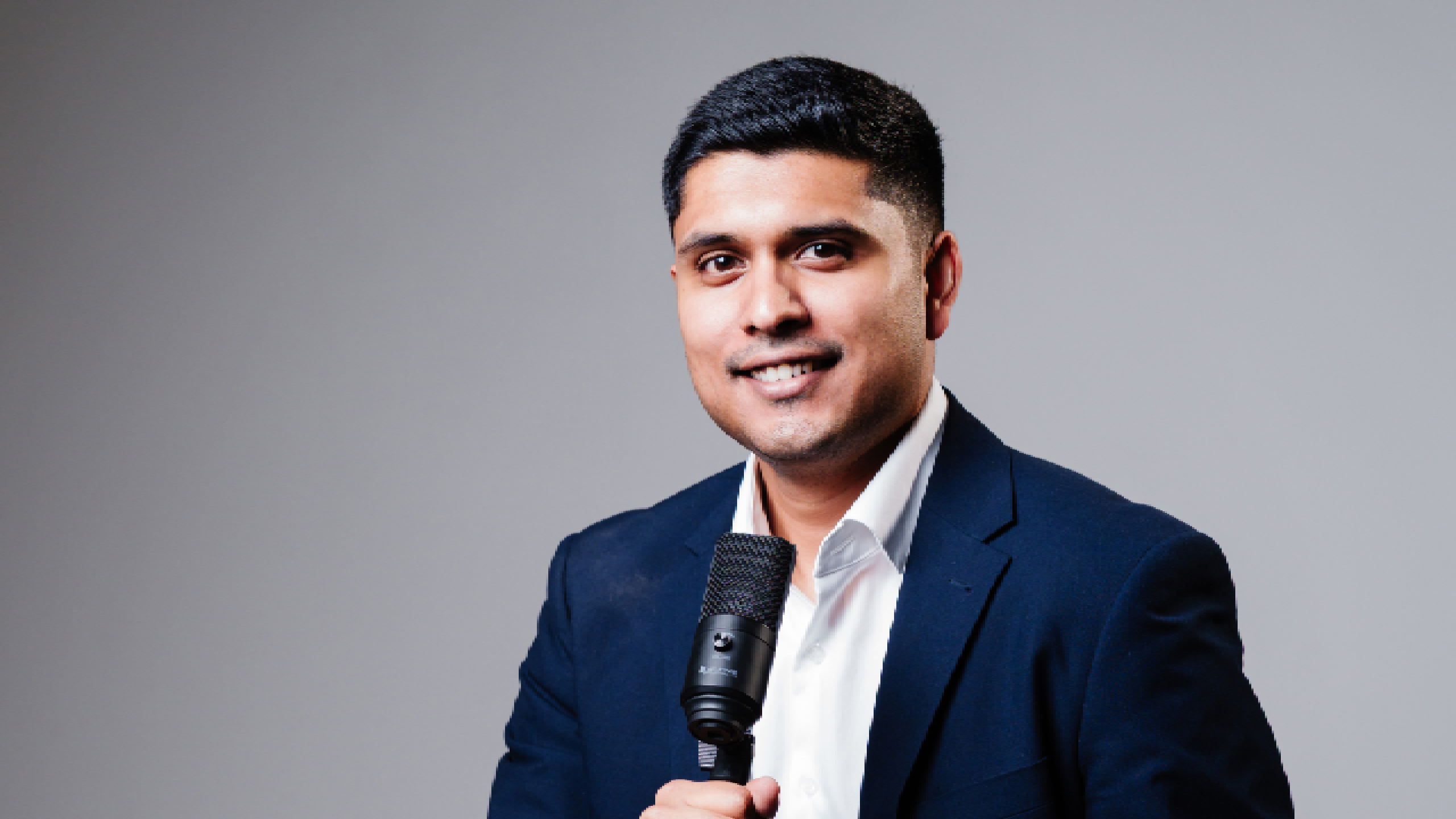
Sed Pillay’s career doesn’t follow a conventional arc. Raised in Durban and academically gifted from an early age, he moved through some of South Africa’s most rigorous educational and corporate environments before becoming one of the country’s most recognisable online comedians. What looks, on the surface, like a sharp pivot from structure to spontaneity is, in reality, an extension of the same analytical mindset—applied this time to humour, culture, and human connection.
Today, Pillay’s work sits at the intersection of entertainment, technology, and community-building. Alongside his comedy and content creation, he is increasingly focused on questions of well-being, connection, and what he calls “sustainable happiness” in an age dominated by algorithms, attention economies, and online performance.
Stefan le Roux and Bryan Welker sat down with Sed Pillay for a wide-ranging conversation that traces his journey from academia and consulting into comedy, examines the social role of humour, explores the limits and unintended consequences of social media, and unpacks the thinking behind his startup, Groops.
The Good Business Journal: Sed, let’s start at the beginning. Where did you grow up, and what did your early path look like?
Sed:
I grew up in Durban, KwaZulu-Natal, and spent the first eighteen years of my life there, from birth until my final year of school. I matriculated with nine A’s and a 94% aggregate, which was obviously very exciting at the time. I then went to the University of Cape Town and, like many people, kind of fell flat on my face.
I started in actuarial science, but by my second year most of my friends had left the programme. I’m quite a social creature, so I began to feel isolated and my grades weren’t great. At that age, you’re also still trying to understand why you’ve chosen certain paths in the first place. Eventually, I switched to a straight finance degree, which was significantly easier, and it gave me a lot more time and breathing room.
After that, I still didn’t really know what I wanted to do, so I went back to the Centre for Actuarial Research at UCT and did a master’s degree in demography—population statistics.
We did a lot of actuarial modelling, life modelling, that kind of thing. I think part of it was just to show myself that I could still do it. That whole academic journey took about six and a half years.
Stefan: And what came after you finished your studies?
Sed:
After university, I moved to Johannesburg and worked in consulting across economics, technology, and strategy, including roles at Genesis, IQbusiness, Deloitte Consulting and Monocle Solutions. That was within about nine months of my first job, which you’re probably not supposed to do, but I’ve always marched to the beat of my own drum.
While I was still with Monocle, the pandemic hit—something none of us predicted—and that’s when I downloaded TikTok. It was honestly just a silly little app at the time. I downloaded it mainly to look at my sister’s analytics. She’s very theatrical and now a full‑time content creator, although she used to be an investment banker—so you can imagine how thrilled our Indian doctor parents were with our life choices.
My dad always said, “Do your degree, do your master’s, and then do whatever you want.” I don’t think he expected this to be the whatever.
Stefan: When did comedy start becoming something real rather than just an experiment?
Sed:
What really got people noticing me in South Africa were the parody songs about load shedding. Singing things like Hello Darkness My Old Friend but making it about power cuts. Those videos got millions of views, and that’s when my following really took off—but then it plateaued.
That’s the tricky thing about social media comedy. You have to recognise when something plateaus and make the correct pivot. After that, I realised people liked it when I sang to my wife while she was cooking in the kitchen, so I started doing that. Those videos did incredibly well.
Later, I started singing about football, especially Manchester United doing terribly, and those videos also took off. When I was living in the UK, I even got invited onto Premier League TV and talkSPORT because of it.
Bryan: I think laughter is spiritually connected to people at their core. When you make a whole room laugh, it levels the playing field. All of a sudden, people on different levels drop down and meet each other in the middle.
Sed:
I completely agree. Comedy breaks down walls, and people become more open and less judgmental. A good joke always has a bit of truth in it.
Stefan: That’s why I think comedians play such an important role in society. They are there to speak hard truths, either to the audience in a way that fosters community, or to people in power to keep them accountable. Kind of like the court jester of medieval times.
Sed:
Exactly. Even today, you can take the mickey out of politicians and presidents and say, “I’m just joking,” but people listening know there’s a real point being made. Comedy lets you say things that can’t always be said directly.
Bryan: You’ve steered away from political content thus far. Why is that?
Sed:
I’ve touched on it lightly before, but I’ve consciously pulled back. I did one piece around South Africa’s newly formed government of national unity that did really well, but after that I became more cautious. We have freedom of speech in our country but calling out political figures comes with a certain amount of stress baked into it.
When I used to sing about Eskom and load shedding, it was fairly innocuous. Nobody really cared—it was just funny. But I’ve never named politicians directly in songs because you never know who’s watching. When I realised I had a mild international following, that made me even more careful. You don’t know how far your content travels or who’s listening.
I’ve also had my mom in my ear saying, ‘They’re going to come for you,’ so I figured it’s safer to stick to singing to my wife while she’s cooking in the kitchen. It gets the views, and it keeps everyone alive. That light‑hearted lens just makes more sense for me right now.
Stefan: If not through politics, how do you see your comedy and platform having an impact beyond making people laugh for a moment?
Sed:
I’ve always been very conscious of how short‑lived laughter can be. People will stop me in shopping malls, ask for a selfie, smile, and then move on. That’s an incredible privilege, and I’m genuinely grateful for it, but psychologically it’s fleeting — it’s a momentary spike, and then life carries on.
That realisation made me think more seriously about what comes after the laugh. You don’t need to be at 100 percent all the time, but if people can sit at a steady baseline — feeling okay, connected, and supported — it fundamentally changes how they show up in the world. I really believe happier people are better people.
That’s why I founded Groops, it’s my attempt at helping people find real, in‑person connections around shared interests, values, and activities—whether that’s a book club, a paddle group, a dog‑walking crew, or anything else. Social media does a great job of showing us content, but it doesn’t always help us build community. Groops is meant to bridge that gap and make connection easier and more intentional.
Bryan: How did the idea for Groops first come about?
Sed:
The idea for Groops really clicked when my wife and I moved to the UK. She was studying in Cardiff, and for the first time in a long time, I found myself without a social circle. I didn’t know anyone. I didn’t have friends there.
What was strange is that I did have followers. People who followed me on Instagram or TikTok started reaching out, asking if I wanted to hang out. Normally, I would have said no, but because I was new and wanted a fresh start, I said yes—and I’m still friends with some of those people today.

That experience made something very clear to me. I had access to connection because of my platform, but most people don’t have that luxury. A lot of people don’t even have a few hundred followers, let alone a way to meet like‑minded people in a new city or environment.
So my focus shifted from asking how I could make someone laugh for thirty seconds to how I could use comedy as an entry point to something more lasting. Comedy is still the vehicle—it’s how I reach people—but the destination is what I call sustainable happiness, and that thinking naturally led me toward building something with a broader, real‑world impact.
Bryan: Having spent quite a bit of time in the UK, what did you miss the most about South Africa?
Sed:
It’s the people, first and foremost. South Africans are incredibly warm. We greet each other at the shops, we check in, we have those small micro‑interactions that seem insignificant but actually add up over time. Something as simple as saying hello, asking how someone is, and genuinely meaning it—that creates a much happier ecosystem.
Being away gave me a real point of comparison. In the UK, people are polite, but they’re more reserved. You don’t get the same sense of easy connection. Here, even strangers will talk to you. Those little moments build a sense of belonging.
I also missed the lifestyle—the weather, the food, the ability to get in your car and go see something beautiful. We have sunshine, we have incredible cultural diversity, and that translates directly into how we live and eat and spend time together. In the UK, the long stretches of grey skies really do affect people. You can see it in their energy.
Absence really made the heart grow fonder. Being away helped me realise just how much we have in South Africa, despite the challenges. There’s a resilience and a lightness here—an ability to laugh at ourselves—that I don’t take for granted anymore.
Stefan: What advice would you give to a young content creator trying to build something today?
Sed:
Don’t quit your day job unless you have enough savings. Believe in yourself, but make sure you have a platform that allows you to do that safely.
Do your research. Understand your audience and your niche. The algorithms pigeonhole you whether you like it or not. I’ve been niched as singing, sports, and couple content—and that’s okay.
And don’t take online hate to heart. I’ve had hundreds of negative comments online, but no one has ever said anything bad to me in person. A lot of hate is just insecurity and jealousy manifesting. Block out the noise and stay focused.
Stefan: A lot of your content is Manchester United-related, and I’m sure your following would love to know what your take on Amorim’s sacking is?
Sed Pillay:
I thought it was necessary. He’s obviously talented, but I don’t think the players were listening to him. United isn’t a 3-4-3 institution. We love attacking football and wing play, and disregarding the academy was a big issue for me.
I wouldn’t have minded Ole coming back—he’s my childhood hero—but I’m keen to see what Michael Carrick does. He’s got a great footballing brain.
Bryan: Finally, what do you believe is South Africa’s greatest strength?
Sed Pillay:
As I’ve alluded to before, it’s the people. We’re resilient, warm, and we know how to laugh at ourselves. We’ve been through a lot, but there’s far more good happening here than bad. I want to use my platforms to show that.
Bryan:
Sed Pillay’s comedy may arrive as a laugh, but it lingers as something more considered. Beneath the songs, the metrics, and the algorithms is a consistent through-line: connection matters. In a world optimised for attention, Sed is quietly building toward something more durable—community, meaning, and a version of happiness that lasts longer than the punchline.
Every week, The GBJ editorial team sits down with some of South Africa’s best. With a tenacity and spirit that can create success out of nothing more than a glimmer of hope, we believe South African businesses deserve a platform to tell their stories.
Born from WDR Aspen, The GBJ wants to ask you: how are you telling your story? Reach out and let us help you with your voice.