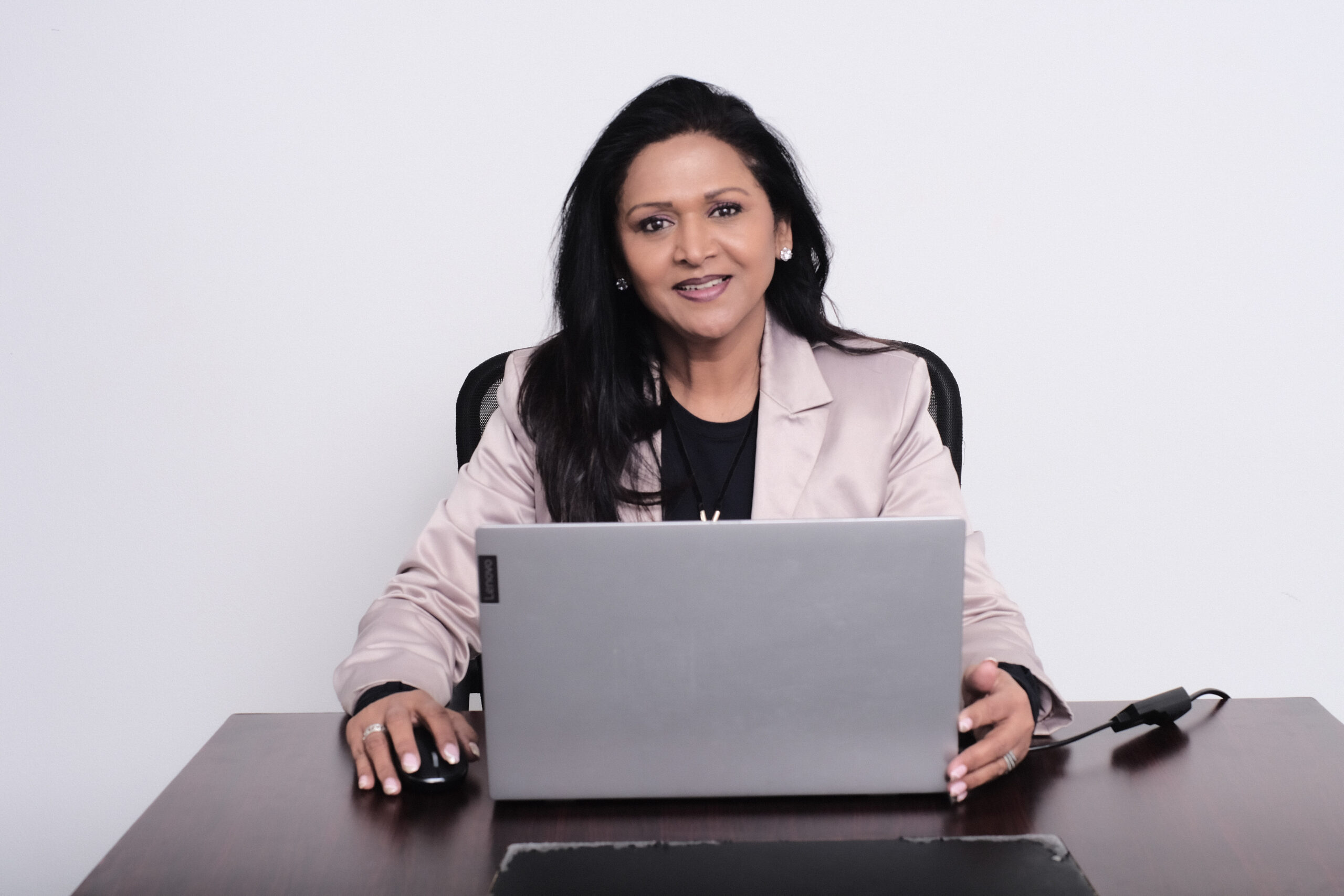
In a country where innovation is often born from necessity, Rita Govender has turned hardship into purpose. As founder of Digital Skills Academy and Disclosure Africa, she’s helping young South Africans navigate the digital economy with confidence.
With a career spanning over two decades in education, HR, and corporate training, Rita has built her life around empowering others—especially women—to find their voice, their skill, and their place in the future of work.
In this conversation, Rita speaks about resilience, mindset, and the power of empathy to transform lives—and why she believes the best way to predict the future is to create it.
Bryan Welker and Stefan le Roux sat down with Rita Govender to trace her remarkable path from a teenage breadwinner catching the 5 a.m. bus to a national leader in digital empowerment.
The Good Business Journal: Rita, you’ve built your career around empowering others in the digital economy. Where does that drive come from?
Rita:
It comes from a life of poverty and uncertainty. I was one of six children, the eldest in an economically struggling household. My father was absent for most times, and I grew up with a couple who had adopted my father on a farm in Umzinto on the South Coast of KZN. When I was five, my parents brought me to the city, and throughout my schooling years, we moved seventeen homes and ten schools.
It was embarrassing for me at the time because divorce was not common in Indian households, especially since most of my peers came from two-parent homes. I always knew I was different, but looking back, that experience made me resilient and paved a way so that I would never be poor or uncertain.
Bryan: That is a harrowing upbringing. How did being the eldest in those circumstances shape your development as a teenager?
Rita:
It forced me to grow up very quickly. By the time I was fourteen, I started working as a sales assistant. I took the 5 a.m. bus to start my shift at 6 a.m. I’d work weekends and use my wages to buy groceries.
I knew no better, for me, working at the age of fourteen was normal. I worked in the part of the city that many people avoided at the time—it was known as the “Black” parts of the city. In a time when “Black and White” people had designated park benches, I learned to communicate with different race groups.
It is through that exposure that today I am confident to drive into a township or an underserved community to empower unemployed youth and women in business. That fearlessness became my superpower later in life.
Bryan: High school is hard enough as it is, as many teenagers might say. How did you cope with moving schools so often?
Rita:
It was incredibly hard, but public schooling was all I had, and being the new student over and over again taught me to adapt fast and be flexible. But it was also humiliating at times. In the 1980s, coming from a broken family in an Indian household wasn’t common.
Bryan: When you look back at that young girl, what do you think kept her going?
Rita:
I remember telling myself, “I’ll never be like my parents. I’ll never be a vulnerable woman, and I would never rely on a man to define me in society.” I decided that education was my way out. I studied hard, even though I had to work after school and on weekends. The instability gave me resilience—it made me realise early that I would have to work very hard so I would not put my own children through poverty or uncertainty.
Stefan: Tell us about finishing school and furthering your studies.
Rita:
I finished matric with strong results, but there was no money for university. I’ll never forget standing in that long registration queue at the Technikon. The registration clerk looked at my results and enquired why I did not register at the university.
At the time, university would cost around R3000 to R4000 for a basic degree, and Technikon was R800 for the year.” No one had ever guided me in choosing a career or advised me on how to apply for financial aid. Looking back, though, I am content. I could not have asked for a better journey. It took a bit long, but the learning was invaluable.
Bryan: What did you study there, and how did it lead to your first professional opportunity?
Rita:
I registered for a National Diploma in Business Computing, what we now call business technology. I was determined to be the best, and I became the fastest typist in my class. That’s what got me noticed.
The Head of Commerce sent my name to the Dean of Education, who needed a typist. That introduction led to my first formal job at the University of Durban-Westville, now known as the University of Kwa-Zulu-Natal.
Stefan: So that’s where your professional career began?
Rita:
Exactly. I was hired as a temporary typist for someone who was on maternity leave, but within six months, the Human Resources department headhunted me because I had studied WordPerfect and Lotus 1-2-3, which were sought-after computer skills in the late 80s. I started working as a personnel clerk in the Human Resources Department and worked my way up to senior HR officer over eight years.
Bryan: And you had been doing all that whilst raising a family?
Rita:
Yes. I was raising two children—my son and daughter—while studying for my BCom degree on a part-time basis. Fortunately for me, one of the benefits is free study at the university. I’d work during the day, pick up my kids, and take them to my evening lectures from six to eight pm every night.
They’d sit quietly at the back of the lecture hall while I studied. It took me five years to complete that degree
Bryan:
Anybody reading this who has children knows how absolutely incredible that is!
Stefan: Your journey eventually took you from Durban to Johannesburg. Can you tell us about that transition?
Rita:
Whilst we were still in Durban, my son applied to study Engineering at the University of Witwatersrand, and subsequently moved to Johannesburg. My daughter also intended to apply to the University of Witwatersrand to study Law, so I knew that my children would study and start careers in Joburg.
This new chapter in our lives encouraged my husband and me to relocate from KZN to Johannesburg. My husband sold his business, and we both came to Johannesburg in 2009, unemployed and unafraid.
It was a rough beginning, but my husband eventually restarted his business, and I began working in training. With limited initial training experience, I began as a coordinator and, after two years, was promoted to regional manager for banking and contact centre learning.
Stefan: What were your main takeaways from that transitory period?
Rita:
That period taught me how to manage large teams in a highly pressurised environment that was driven by numbers. In one of my roles as a national training manager for a BPO contact centre, I saw agents being treated as though they were robots—they were trained only in processes, systems, and products.
Many were young people from underserved communities, earning very little. I saw mothers bringing their babies to night shifts because there was no one else to watch them.
That was the breaking point for me. I realised I wanted to create something different—an environment where training included personal growth and self-development, not only for skill but for life-long learning.
Bryan: Was that the moment you decided to start your own company?
Rita:
Yes. In 2019, when both my children were married, I finally felt ready. I left my corporate job and decided to go out on my own.
I was initially uncertain about my business direction. I spent the first six months training to become an Agile Leadership Facilitator through Mgt 3.0 in the Netherlands, followed by training to become a licensed Enneagram Practitioner (a U.S.-based personality profiling system); I then merged these two disciplines to design my own workshops focused on self-awareness, leadership, and emotional intelligence.
Bryan: And then, just as you were gaining traction, COVID hit.
Rita:
Exactly. My first public workshop happened in January 2020, and by March, everything had come to an abrupt halt. I didn’t give up, though. I adapted the workshops for online delivery and began training entrepreneurs remotely.
During lockdown, I worked with around 200 entrepreneurs through a Jobs Fund initiative. When restrictions eased, I was asked to launch a follow-up training programme, which I took on even though it meant pausing my own project for a while.
Stefan: You must have had your fair share of COVID exposure with all that travel and contact work.
Rita:
I did, yes. In 2021, during the Delta wave, I became seriously ill—it was the worst strain of the virus. At the time, I obtained funding to train 200 youth and was nearing the end of the project. I had completed training 165 youth and had 35 left to train. Even from bed, I refused to let the programme fail.
I identified my brightest student, trained him over the phone, and paid him to complete the sessions for me.
He managed the paperwork, collected compliance documents, and produced the registers. That experience showed me what leadership really means—empowering others to rise when you can’t.
After that project, I was asked to help set up a training company. I ran it successfully until 2024, but eventually, I wanted to build something that reflected my own vision.
That’s when I established my company, using a digital-economy model. I don’t employ permanent staff; instead, I collaborate with existing training providers that have the infrastructure and the capacity to take on my training.
I use their trainers and venues under my accreditation and run everything through project-based contracts. It keeps overheads low and impact high.
Bryan: That’s a very modern approach to business—lean but effective!
Rita:
It allows me to help other training providers survive while expanding reach into more communities. I’m proud of that. It’s not about building an empire; it’s about building sustainability for everyone involved.
Stefan: What would be your message to young women in South Africa today?
Rita:
Self-awareness and self-efficacy. Know who you are, know others, and know your environment.

Stefan: Self-awareness, can you expand on what that means to you?
Rita:
Knowing yourself means being fully aware of your blind spots, your triggers, your strengths, and where you still need to grow. That’s the first step to becoming a good leader.
When you can recognise your own reactions and patterns, you begin to see them in others, too—and that’s where empathy begins. Meeting people where they’re at, seeing their reality before you speak theory or offer solutions, that’s what empathy really is.
Self-awareness allows me to connect with individuals from communities that suffer immensely—physical and sexual abuse, poverty, you name it. And by connecting with them and earning their trust, I can teach them the self-awareness to understand that their circumstances don’t have to define their future.
Bryan: That is so profound. On the topic of the underserved communities and their future, what is the status of the underprivileged in South Africa in relation to the digital world and AI?
Rita:
The reality is that most rural youth still don’t have access to reliable connectivity or proper exposure to digital tools. In South Africa, only around 22% of households in these communities are digitally connected. So when we talk about AI, many of them see it as something that is unknown and possibly a threat.
My research through AI awareness workshops with Grade 11 public school learners showed me that what they really need isn’t coding lessons or robotics labs, but AI preparedness for future education and careers in a South African context. They want to understand what careers exist around AI, how it will affect the job market, and what skills they should obtain to be ready for a digital economy.
Once they realise that AI can create new jobs—bot analysts, bot technicians, data support roles—the fear shifts to curiosity. The key is to make people unafraid of technology, to show them that the future isn’t replacing them; it’s inviting them in. The future has always been scary, but the best way to predict the future is to create it.
Stefan: You touch on the concerning fact that only 22% of households in these communities enjoy connectivity to the internet, and an even more shocking statistic is the 33% unemployment rate. What is your role in bringing those numbers down?
Rita:
As soon as training providers realise that South Africa doesn’t just have an unemployment problem but an unemployability problem, we can begin to change it. Many people want to work, but they’re not being given the right kind of learning to match the changing labour market.
My goal is to make South Africans employable in the digital economy, so they can create sustainable livelihoods for themselves instead of waiting for someone to hire them.
Bryan: Do you have some surefire steps for an unemployed person reading this that might get them on the right path?
Rita:
If you change the way you think, anything is possible; an abundance mindset over a limited mindset.
In the communities where I teach, I show people how to upgrade their CVs even when they don’t have formal work experience. I give them access to free online sites where they can learn coding and other small skills to add to their CVs.
I tell them to ask a neighbour or a local business if they can shadow them or help out—sometimes all you need is exposure and experience, not a salary. If you have to travel, just ask for transport money. The key is to stay active, keep learning, and never stop improving yourself, even when no one is watching.
Stefan: Rita, this has been eye-opening. Before you go, if you happened to find yourself in a conversation with a foreign investor, what would you say is South Africa’s strongest selling point?
Rita:
Manufacturing. We have the raw materials—the workforce, the climate, and the coastline to support it. We have millions of unskilled workers ready to be trained and ports to export from. If more international companies invested in manufacturing here, we could transform entire communities.
South Africa doesn’t need sympathy; it needs opportunity. With the right investment and the right leadership, we can rebuild faster than anyone can imagine.
Rita’s story is one of transformation through purpose. From a teenager catching the 5 a.m. bus to a national leader in digital education, her journey embodies what South African resilience looks like in motion. What makes her message so powerful is its simplicity: that self-awareness and empathy are not just leadership tools—they’re survival skills in a changing world.
She reminds us that transformation doesn’t begin with policy or infrastructure; it begins with the individual, with one person deciding to learn, adapt, and lift others along the way. In a country facing immense challenges, Rita Govender proves that fearless, purpose-driven people will always find a way to build a future worth believing in.
Every week, The GBJ editorial team sits down with some of South Africa’s best. With a tenacity and spirit that can create success out of nothing more than a glimmer of hope, we believe South African businesses deserve a platform to tell their stories.
Born from WDR Aspen, The GBJ wants to ask you: how are you telling your story? Reach out and let us help you with your voice.