
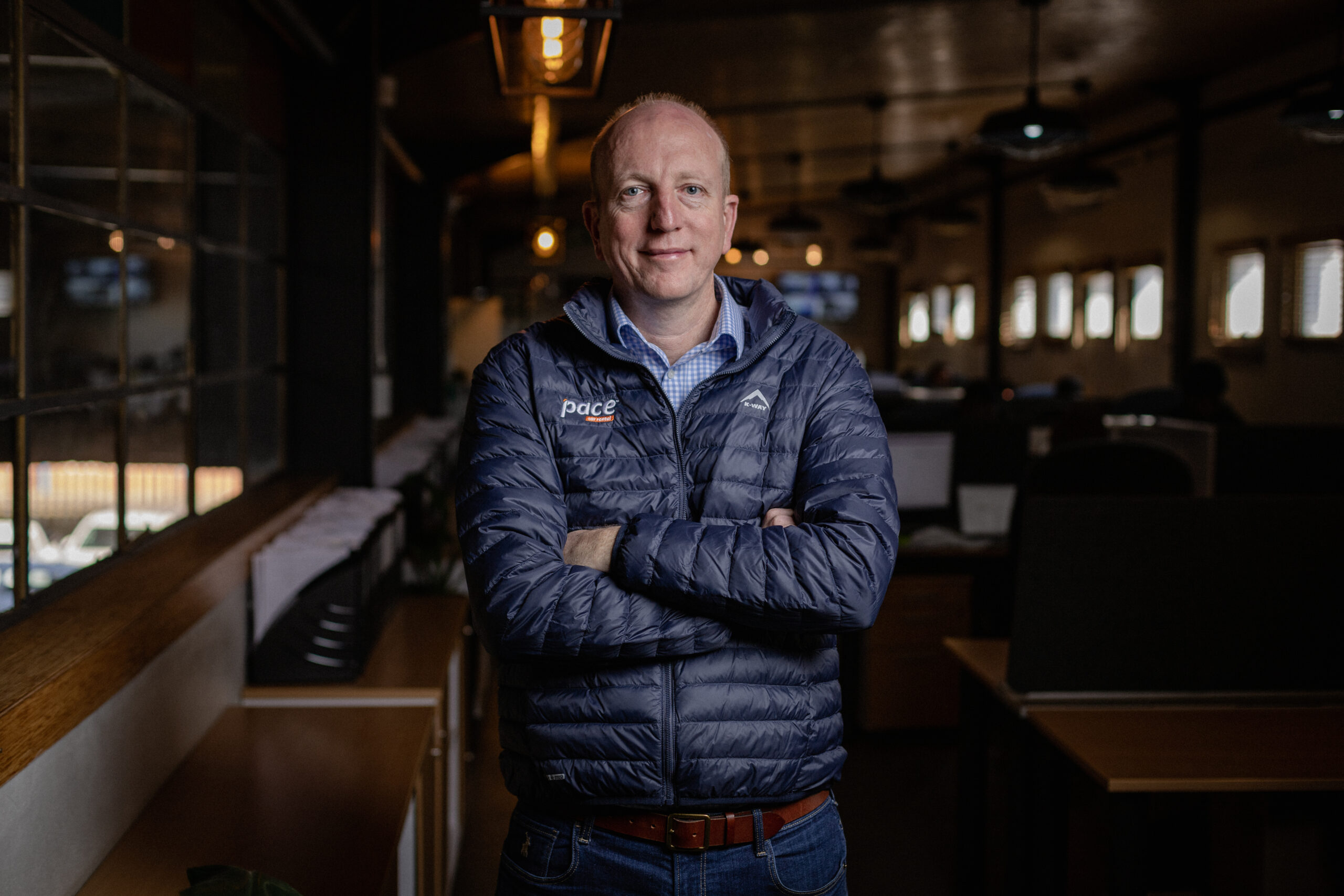
There’s a particular kind of entrepreneur who doesn’t wait for the perfect idea, the perfect funding round, or the perfect moment—they simply start with what they have. Grenville Salmon is one of them.
From a single borrowed car to an R1 billion business, Grenville Salmon has built Pace Car Rental into one of South Africa’s largest independent vehicle hire companies, with over 5,000 cars and 400 employees. His story isn’t one of sudden fortune or inherited advantage—it’s about grit, faith, and an unshakable belief in progress.
We sat down with the Johannesburg-born founder to talk about his journey, his leadership philosophy, and the lessons he’s learned about building something that lasts. Throughout our conversation, one phrase surfaced again and again—the idea that in life and in business, you simply have to play the cards you’re dealt.
Bryan Welker, Stefan le Roux, and Jessica Rosslee sat down with Grenville Salmon to unpack the drive, discipline, and defiance that turned one borrowed car into a fleet.
The Good Business Journal: You’ve built an empire from humble beginnings. What were those early years like for you?
Grenville:
I grew up between Johannesburg and Durban. Benoni was where I went to school, and it wasn’t an easy place—a bit rough around the edges. But I think that’s where resilience starts. I was a very average student, played a bit of sport, and took higher-grade maths for some reason. It wasn’t a school full of soul like the Durban ones, but maybe that’s what toughened me up.
Bryan:
That’s inspiring, because I bet someone from your old high school will read this and think, “If he can make it from there, maybe I can too.”
Grenville:
After matric I took a gap year in the UK, came back, and realised I’d wasted time. That’s when I decided to get serious. I went to Wits, qualified as a chartered accountant, and that gave me a foundation I could build on.
GBJ: Your career started in corporate finance before taking a very entrepreneurial turn. What drew you out of that world?
Grenville:
I started my career at Deloitte in their chartered accountants programme. It was incredible training—they put a lot of effort into shaping their people. One of their mottos was learn, earn, and grow. It stuck with me.
After a few years, I joined Imperial Car Rental, one of our biggest clients at the time, and that’s really where the spark hit. I saw how the business worked, where it didn’t, and I thought, I can do this better. That thought never left me.
Bryan:
That simple line—“I can do this better”—must be the thought that has started almost every billion dollar company!
GBJ: You literally started Pace Car Rental with a borrowed car. How did that come about?
Grenville:
Yes, it’s true. I had just bought a minibus to rent out, and my first booking came in—but they wanted a car, not a minibus. My mum had a VW Golf with low mileage, perfect rental spec. So I swapped her cars. She drove my old one, and I rented hers out.
I spent that night at my dining room table designing the rental contract in Microsoft Paintbrush and writing the terms and conditions by hand. By the next morning, everything was ready for my first client. When he signed that agreement, I knew—this was it. That was the start of Pace.

GBJ: You’ve now scaled to more than 5,000 cars. What mindset carried you from one car to thousands?
Grenville:
You just have to start. Don’t wait for the conditions to be perfect, they never are. We reached 100 cars before I quit my job, and I remember thinking if it stayed like that forever, I’d be happy. Then a year later, we were at 400.
People often think entrepreneurship is about luck or timing, but it’s really about perseverance and dealing with problems one at a time. At some point, I realised that if I let every problem ruin my day, I’d die from stress.
You can choose whether something ruins your year, your day, or just your minute. You learn to deal with it, move on, and keep going.
GBJ: That calm seems rare in business. How do you manage pressure with 400 employees and thousands of vehicles?
Grenville:
It comes down to perspective. At some point you just accept that things will go wrong—cars get crashed, systems break, people make mistakes. The key is not to let it define your day.
I use a method from a book called The Goal, which is about constraints management. I always ask: What’s the bottleneck right now? If you can identify that and solve it, everything else flows. Not everything has to be perfect; it just has to move forward.
GBJ: How has your role as a leader evolved as the business scaled?
Grenville:
When the business was smaller it was easier because I knew everyone personally. Now that isn’t the case anymore so something that I try to communicate to my managers is that they have to believe in their people.
Sometimes all it takes is one person who believes in you to change your life. If you give someone a chance, talk to them about how to grow, or help them see the next step in their career, it can be life-changing. We’ve had employees build houses, send their kids to private schools—that’s what makes me proudest. The impact you make on people’s lives is what really matters.
Bryan: That’s powerful! So many of us can trace our careers back to that one person who believed in us before we believed in ourselves. It’s why I think great leadership is equal parts vision and faith—seeing what people can become before they do.
GBJ: You’ve also started an educational trust through Pace, correct?
Grenville: Yes, we’ve got over 40 kids we’re supporting—paying for their schooling or extra-murals. Fifteen of them we’ve taken out of township schools and placed in private schools.
It’s not charity. It’s an investment in the next generation. If one of those kids changes their family’s trajectory, that’s success. It’s easy to forget how much that matters when you’re focused on growth, but that’s what it’s all about.
GBJ: South Africa is a challenging place to run a business—load shedding, fuel costs, access to credit. How do you stay resilient?
Grenville:
Every one of those things is a barrier to entry. That’s how I see it. They’re frustrating, sure, but they also make it harder for competitors.
There’s a Shakespeare line: “Nothing is good nor bad; it’s the human mind that makes it so.” You can look at challenges as obstacles or as opportunities. If you can do difficult things consistently, you’ll survive—and in South Africa, surviving often means thriving.

GBJ: What gives you an edge against the big global car rental brands?
Grenville:
They’re all run by very capable local people, but they rent the brand, and that comes with rules. It’s like running a Spur franchise; you can’t go and add sushi to the menu, even if it would turn a profit. I can change the menu tomorrow if I want to.
That’s our edge—adaptability. We built something that’s uniquely South African, with flexibility those global systems don’t have. I can respond faster, build relationships, and design solutions for our market, not someone else’s.
GBJ: You’ve mentioned golf as a hobby. Does it influence how you approach business?
Grenville:
Golf teaches humility. I take a lot of risks on the course, and they don’t always come off. It makes me wonder how many risks I’m taking in business.
Bryan:
Golf’s taught me mostly that golf balls are expensive, but I’ll never lay up.
Grenville: (laughs) Exactly. That’s the beauty of golf. There’s no real consequence, so you can go for it. In business, there’s always a cost—people are counting on you. Still, you have to take smart risks. You can’t grow without swinging for something once in a while.
GBJ: Is investing in South Africa a smart risk?
Grenville:
Yes and it’s because of the people. South Africans are friendly, resilient, and free-thinking.
We have a free country—despite the corruption, despite the noise—we can speak our minds. That’s powerful.
In some countries, people are afraid to make decisions or to talk about what’s wrong. Here, we argue, we hoot at each other, we complain, and that freedom to communicate means opportunity.
We’re not afraid to try. That’s the real difference.
Bryan: From an American perspective, I think that’s what makes South Africa remarkable—that mix of chaos and courage.
GBJ: If you could give one piece of advice to a young entrepreneur, what would it be?
Grenville:
Play the cards you’re dealt.
Too many people are trying to play someone else’s hand—chasing funding, waiting for perfect conditions, or comparing themselves to others. Use what you have.
When I started, I didn’t have investors. I had a job, so I worked, saved, and built my capital. If all you’ve got are your hands and your willingness to work, start there. Create value with that. It’s not glamorous, but it’s real.
Q: How do you define success today?
Grenville: Success is being able to give your children a good start in life—sending them to a good school, giving them opportunities. Everything after that is just cream.
That’s why we built Pace—to create a business that not only survives but uplifts. If I can do that, I’ve succeeded.
In a world obsessed with unicorns and overnight success, Grenville Salmon’s story is refreshingly human. It’s about the quiet courage to start, to keep going, and to lift others along the way. It’s about the steady, unglamorous discipline of showing up every day and building something real.
Salmon’s success serves as a reminder that greatness isn’t always loud—sometimes it sounds like a phone ringing in a small Johannesburg office, a single booking that sets a lifetime of momentum in motion.
Every week, The GBJ editorial team sits down with some of South Africa’s best. With a tenacity and spirit that can create success out of nothing more than a glimmer of hope, we believe South African businesses deserve a platform to tell their stories.
Born from WDR Aspen, The GBJ wants to ask you: how are you telling your story? Reach out and let us help you with your voice.