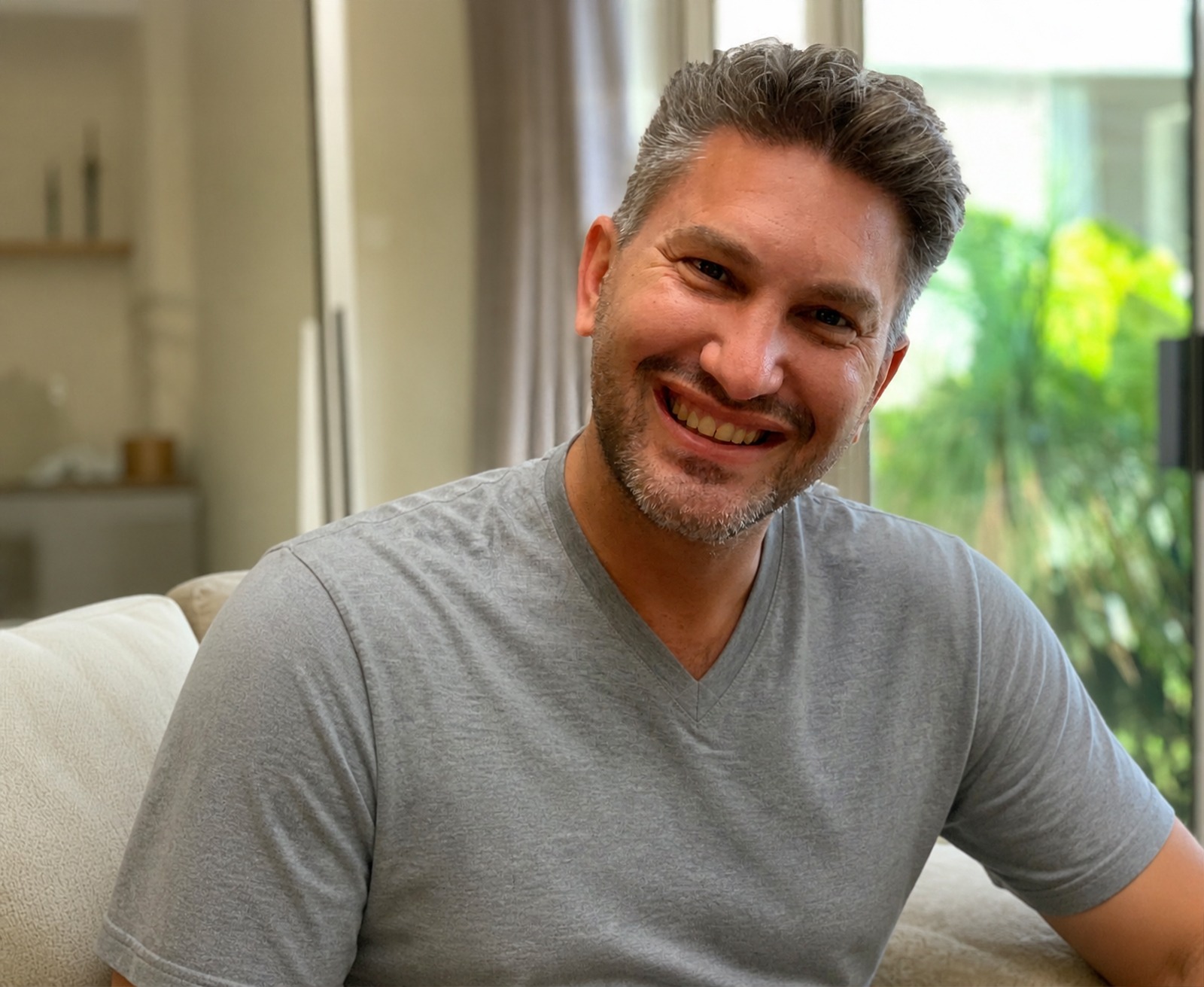
Shaun Woolf’s relationship with food started early, shaped by exposure to a range of kitchens and food cultures. His early working life followed a similar rhythm—moving through different environments, picking things up along the way—eventually culminating in what we now recognise as The Kitchen Mafia. And while the end product is easy to point to, what it took to rebuild it—after everything was lost—is not.
Stefan le Roux sat down with Shaun Woolf to unpack the series of hard lessons that led him to clarity and wisdom. The kind that separates perception from reality, creativity from execution, and ultimately, the business from the person behind it.
The Good Business Journal: We like to start right at the beginning. Where did you grow up, and how did your early years shape your journey?
Shaun:
I’m from Sandton—sounds very la-di-da now—but back then it felt very small still. There were farms around and we’d ride bikes, skateboard, play in the river. It was a great childhood.
School wasn’t easy for me. I was told I had a learning disability and got moved into a different school. Eventually, a teacher told my parents there was nothing wrong with me—I just needed to catch up. I worked hard, got into Crawford, and later King David. But I never really fit the “book smart” mould. I was happy with B’s and C’s. I wanted to play sport and be active.
What shaped me more than school itself was exposure.
Stefan: What kind of exposure are you talking about?
Shaun:
I had friends from all different cultures—Italian, Greek, and more—and I was always in their homes, in their kitchens. That had a big impact on me.
After watching my friends’ moms cook, I still believe the best cooks in the world are those moms and grannies who just know what they’re doing. The flavour, the feel, the passed down recipes—it’s instinct.
Later on, I worked in kitchens as a teenager, and that was a different story. I realised something quite quickly—food isn’t as creative as people think.
You design a menu for a season or just once, but after that, you’re in production. You’re making the same dish over and over again.
That was a fundamental lesson for me.
Stefan: What did you do after school?
Shaun:
I went into IT initially. I did the courses, started working, but I didn’t love it. People only call you when they have a problem.
A mentor asked me a simple question: do you love computers, or do you love technology? That hit me. I loved the idea of tech, figuring things out—but not fixing people’s computers all day.
So I moved on. I worked in an art gallery and helped run exhibitions. Again, a creative environment, but I still didn’t quite know what I wanted to do.
Stefan: How did the pivot to the hospitality industry materialise?
Shaun:
I went for lunch with my dad at Bread Basket, and we ran into the guy who had just taken over there. My dad basically said, “Shaun doesn’t know what he wants to do—why don’t you take him in?”
He offered me a job. It was One-third of my previous salary, six days a week, and starting at 5:30 in the morning, but I said yes.
After about a month, he handed me the keys and said, “Sink or swim.”
I was 25, managing 40 staff. It was intense. You’re doing tens of thousands of steps a day, dealing with suppliers, customers, stock, quality—it’s everything.
That was my real education.
Stefan: What did you take from that experience?
Shaun:
My dad gave me one piece of advice that stuck: run it like it’s your own business.
That changed everything. You stop thinking like an employee. You care differently. You notice things. You take responsibility.
I couldn’t sleep some nights worrying about that business, and it wasn’t even mine.
I learnt a lot about people and about respect. People always say the customer is king—and they are—but so are your suppliers. That’s where your product comes from. If you don’t give them the respect they deserve, you don’t have a business. Screaming and shouting is always counterproductive.
Stefan: How did All About Food start?
Shaun:
It started very organically. A friend’s mom, an incredible cook, suggested we do private dining. We started cooking in people’s homes. That was the beginning.
It grew over time. Slowly. There were a lot of lessons along the way—what some might call failures—but I’ve come to see them as the uncomfortable moments that force you to grow.
Stefan: Was there ever a moment you questioned taking an entrepreneurial path?
Shaun:
All the time.
You see your friends in stable jobs, earning salaries, going out at night, and you’re waking up at 5am, working until 10pm, trying to build something.
You question it constantly.
But you keep going.
Stefan: Then COVID hit.
Shaun:
Yeah. That was… everything.
We had built something strong. We had a great deal with Investec, a beautiful space. Things were working.
And then—gone.
We lost millions. Personally, I lost everything—I went through a divorce at the same time.
There were moments when I couldn’t pay staff. I had to go to my kids’ school and say, “I can’t pay school fees. What do I do?”

That’s not an easy conversation.
People see the finished product and where I am now, but they don’t see that part.
Stefan: How did you keep going?
Shaun:
I think I’m naturally positive. I believe there’s a lesson in everything—even when it doesn’t feel like it.
You also have to take responsibility. You can’t just say, “This happened to me.” You have to ask, “What can I do differently?”
Stefan: How did the transition from All About Food to Kitchen Mafia happen?
Shaun:
It was survival. COVID wiped us out. We lost everything.
I had to start again—from the bottom. I went back to small clients, collaborations, even work where I wasn’t really making money, just to keep things moving. The model changed, the way we worked changed—I had to figure out what still made sense and what didn’t.
It wasn’t a quick fix. It took time—years of just putting my head down and rebuilding, piece by piece. What came out of that was a more flexible way of operating—less tied to one format, more focused on experiences and the kind of work people actually needed at the time. Over time, that evolved into what is now Kitchen Mafia.
Stefan: What’s the biggest lesson you’ve learned through all of this?
Shaun:
Separating yourself from your business.
I used to take everything personally. If something went well, I was high. If something went wrong, I was low.
Through coaching, I realised: Shaun is not All About Food. Shaun works for All About Food.
I need oxygen and food to live. The business needs money to survive.
That separation changed everything.
Stefan: How important has coaching been to you?
Shaun:
Huge.
A coach doesn’t give you answers—they ask questions that make you think. That’s powerful.
It’s the same reason I believe in things like relationship coaching. Why wait until something is broken? Why not work on it proactively?
Running a business is the same. You need space to think and having guidance in that regard can help.
Stefan: What keeps you in South Africa?
Shaun:
I actually think it’s easier to start a business here than overseas.
In Europe or the US, everything is structured and regulated. It’s harder to just start something.
Here, there’s opportunity. There’s energy. People want to do business.
Yes, there are challenges—lack of support, infrastructure—but there’s also freedom.
And there’s something about the people, the community. We know each other. We build networks.
The grass might be greener somewhere else—but that doesn’t mean it’s better.
What emerges from Shaun Woolf’s way of working is a handful of powerful rules. Don’t be married to creativity; design your product, then execute. Run anything like it’s yours, because someday it might be. Respect everyone in the chain—not just your customer. And when things go wrong, let the first question you ask be, “What can I do differently?”
They sound obvious. They aren’t. They’re the difference.