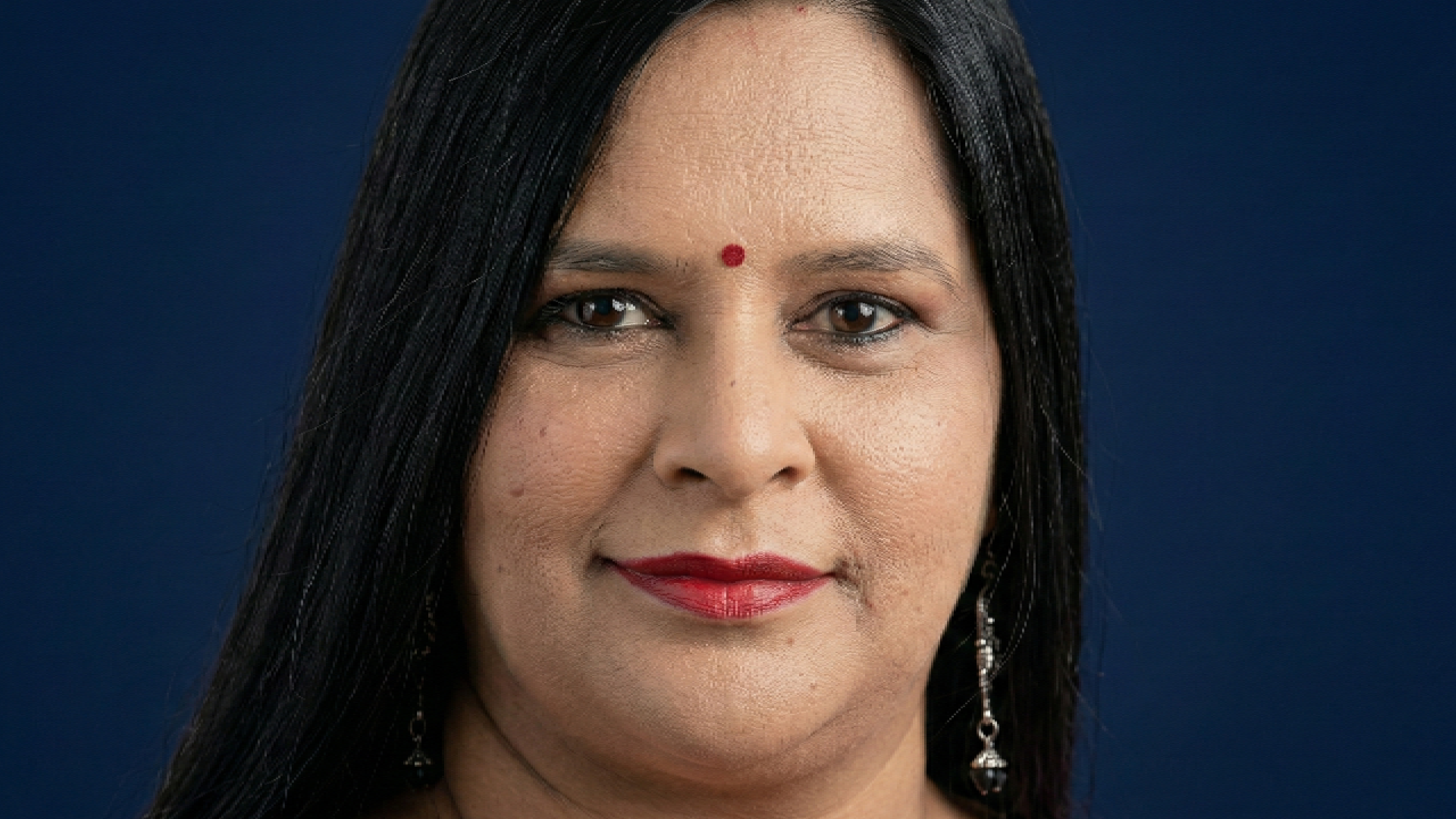
In 2018, during the final stretch of her LLB, Nalinee Moodley was diagnosed with a tumour on her brain stem and given a prognosis no one is ever ready to hear: death or paralysis. What followed would test her in ways few people are ever prepared for—physically, emotionally, and spiritually.
Today, her work extends far beyond legal practice. It lives in the young people she mentors, the communities she serves, and the quiet conviction that resilience is something you practice daily.
Stefan le Roux sat down with Nalinee Moodley to trace the journey from diagnosis to qualification, and from survival to service—unpacking the internal resolve that carried her through it all.
The Good Business Journal: Nalinee, where were you born, and what was your schooling like?
Nalinee:
I was born at St Aidan’s Hospital in Durban, but I’ve lived on the South Coast my entire life. I grew up in Marburg Ridge and later moved to Marburg, attending Port Shepstone Primary and then Marburg Secondary School.
At school, I served as deputy head prefect and was one of two students selected to attend a week-long Rotary leadership course with learners from across KZN. It was based on both academics and character, and being chosen meant a great deal to me.
After matric, I enrolled at the University of Durban-Westville to study a BCom and spent two years there. When things didn’t work out, I returned home and continued my BCom through UniSA, although I ultimately did not complete the degree.
Stefan: How did your working life unfold from there?
Nalinee:
I got married, and in December 1996, my son was born. Soon after, nearby schools called me in for locum teaching, which rekindled my love for education.
I then spent two years on contract at Permanent Bank before taking a secretary’s role at a primary school—an environment that suited my family life and drew me back toward teaching.
I registered with North West University and completed my National Professional Diploma in Education, followed by an Advanced Certificate in Education and an Adult Basic Education and Training qualification through UniSA.
Once I was in the rhythm of studying again, I decided to complete as many relevant qualifications as I could.
Stefan: At what point did law enter the picture?
Nalinee:
While I was teaching—at one point managing close to 400 learners—my brother would see me buried in marking and administrative work. One day he said to me, “You know what, you must actually study law. It will be good for you.”
At that stage, I had already completed several qualifications and genuinely believed I was done with studying. But I love my brother deeply, and his encouragement meant a great deal to me. I decided to register for my LLB, partly as a way of honouring his faith in me.
I began my law degree part-time through UniSA while still teaching full-time. It was demanding—balancing 400 learners, studies, and family life—but I pushed through.
In March 2017, my marriage ended after 20 years. A few months later, in August 2017, I resigned from teaching to begin my articles. I officially started my articles in May 2018.
Stefan: When did you first realise something was wrong with your health?
Nalinee:
In November 2018, during the final stretch of my LLB exams, I began feeling unwell. I pushed through and wrote my last paper, but afterwards, I went to the doctor to find out what was wrong. Within a day or two, I was admitted to the hospital and diagnosed with a tumour on my brain stem.
Looking back, the symptoms had seemed minor at first—pain in my eye, slight numbness in my face, and persistent fatigue. It wasn’t dramatic, just an uncomfortable feeling in my eye that gradually became harder to ignore.
Stefan: What were you told after the diagnosis?
Nalinee:
They discharged me and told me there was nothing more they could do. The prognosis was blunt: death or paralysis.
They explained that operating on the brain stem was extremely risky—any interference with those nerves could leave me permanently paralysed. So I went home to my mum in Shelley Beach with no treatment plan, only the advice to pray and wait to see what would happen.
Stefan: How did you end up getting help?
Nalinee:
My brother reached out to professors in Cape Town and asked them to help. They offered us an appointment in December 2018. When we travelled up, they were honest: they would attempt surgery, but there were no guarantees.
While we waited, my condition deteriorated. I struggled to move, experienced double vision, and found even simple mobility difficult. It was an increasingly challenging period.
Stefan: Even then, you were thinking about finishing your degree. What happened?
Nalinee:
By mid-December, the UniSA results were released. I had achieved three distinctions and a solid pass in another paper. The only subject I failed was the final one—the paper I had written while struggling to see thanks to the tumor.
Instead of focusing on the diagnosis, my mind went straight to the degree. I thought, “This is my last paper. If I pass it, I’ll complete my LLB.” Even though UniSA was closed for the holidays, I began researching my options and discovered something called an F1 concession, which allows final-year students a chance to complete outstanding modules.
Despite it being Christmas and New Year, I emailed the university and began the process. Knowing there was still a path to finishing my degree gave me a renewed sense of purpose. It felt like a new lease on life.
Stefan: What happened next?
Nalinee:
The university requested medical proof, so I submitted letters from my doctor and the hospital. They approved my application to complete a portfolio instead of rewriting the exam.
My surgery was scheduled for the 22nd. On the 18th, I submitted my portfolio to UniSA before travelling to Cape Town. The operation lasted six hours. During the procedure, my face began collapsing, and the surgeons were forced to stop. Continuing would have risked permanent facial paralysis similar to Bell’s palsy.
They were unable to remove the entire tumour because it was too dangerous. Radiation was the next step. I underwent 30 treatments and was warned that paralysis or further complications were possible—there were no guarantees.
On the morning I began radiation, I received an SMS from UniSA: “LLB degree completed.” For me, that message marked a turning point. It felt as though life could begin again.
Stefan: Where did you find strength when it felt like everything was coming at once?
Nalinee:
My brother and my sister are incredible, and I wouldn’t have made it without their care and support. I am so fortunate for the community I grew up in; they have been with me every step of the way.
My boys are my strength. They keep me going. They care deeply about me and are always looking out for me—whether it’s reminding me to be careful in the rain or making sure I don’t carry anything too heavy. After everything—the surgery, the radiation, and then losing my mum so suddenly—they became my anchor.
Mum and I were very close, almost like sisters. When she passed away in her sleep in June 2019, just weeks after I returned from Cape Town, it felt like another wave had hit before I had fully recovered from the first. But I still had to stand up.
I had my graduation to attend, my practical legal training to complete, board exams to write, and articles to finish. The boys needed me to be steady.

One of my friends referred to me as Job in the Bible. She said, “Life keeps throwing challenges at you, but you’re still smiling, you never give up.” I’ve held onto that.
Life is too short to sit glum. We just have to do our best. I see my life with all its shattered pieces as a beautiful mosaic.
Even now, I still have the tumour. I don’t focus on it. I live with constant headaches, and I’ve lost hearing in my right ear, but it’s something I manage. Someone once asked me what medication I take. I said, only prayer.
Stefan: How did your experience influence the way you serve others?
Nalinee:
Service, for me, is not something I do for recognition. It’s how I was raised. I am so grateful to my community concious parents for moulding me into the person I am today.
I am a member of Rotary, and I support Hospice, but I don’t often speak about it at length. If I hear that someone needs help, I simply try to respond. Sometimes that means contributing to food hampers or school stationery drives. Other times it means offering guidance to a young person who feels lost. It’s not about the scale of the act—it’s about showing up where there is a need.
Since my diagnosis, I’ve realised that one of the most meaningful ways I can serve is by speaking to young people. Schools invite me to talk about career choices and resilience. Parents ask me to guide their children. I tell them honestly that life will not always move in a straight line.
I studied while teaching hundreds of learners, navigated through my marriage, faced a brain tumour, lost my mother, and still completed my degree. Not to impress them—but to show them that setbacks do not have the final word.
Through Rotary, I mentor learners attending leadership programmes similar to the one I attended as a teenager. Our firm hosts students, takes them to court, and exposes them to different paths within law. I see myself in many of them. If someone hadn’t invested time in me when I was young, I wouldn’t be where I am today.
Stefan: What advice would you give to the next generation?
Nalinee:
My advice is simple, but it comes from experience and lessons learnt.
Be honest, and be willing to work hard. Honesty and hard work will take you far. Laziness will not.
Also, don’t give up when life becomes overwhelming. Sometimes challenges come all at once—illness, loss, disappointment. But your circumstances do not define your destiny. If you truly want something, you can work toward it.
When life throws you challenges, you can choose to be bitter or choose to be better. I chose to become a better person.
One of my favourite books is Louise Hay’s You Can Heal Your Life. It focuses on mindset and taking responsibility for your thoughts. I often encourage young people to read it because your thinking shapes your direction.
And above all, I remind them of one phrase that carried me through everything: “All is well.” It doesn’t mean life is perfect. It means you trust that you will find your way.
In the space of a few years, Nalinee faced illness, uncertainty, loss, and the weight of responsibility—and chose, repeatedly, to move forward with the belief that God is a miracle worker and will ensure that All Is Well.
Today, that same resolve shows up not only in her legal career but in the ways she invests in her community.
For the young people who sit across from her seeking direction, she represents living proof that adversity does not have to define the ending. Sometimes, it refines it.