Some people set out to build companies. Others simply refuse to lower their standards and, in the process, build far more than they ever intended. Tim Evans belongs firmly to the latter camp. Long before Malvah Studio existed or Odd Ritual took shape, Tim was a kid on the South Coast chasing stimulation wherever he could find it: skating, drawing, surfing and taking buses to Durban just to be around colour and culture.
What makes Tim’s story compelling is how unforced it is. He did not build a design studio because he had a business plan. He built one because the work demanded a home. He did not start a golf apparel brand to fill a market gap. He made clothing because nothing on the course reflected the world he came from. Even leadership arrived quietly, gradually and almost reluctantly. What emerges is a portrait of someone who builds from conviction rather than ambition, from craft rather than ego and from the belief that if something should exist, you roll up your sleeves and make it real.
Bryan Welker and Stefan le Roux sat down with Tim Evans to unpack the mindset behind it all: the discipline to hold a standard when no one is watching, the courage to build without certainty, the clarity to stay committed when shortcuts are tempting and the purpose to create work and culture that outlasts the moment.
The Good Business Journal: Tim, let’s start with where all of this begins. Tell us about how you grew up.
Tim Evans:
I was born in Amanzimtoti and moved to the South Coast of KZN when I was two. My dad planted a church there, and my mom was a graphic designer, amongst other things—always drawing, sewing, making things. My creativity definitely came from her.
I went to a primary school called Evangel, now known as South City, and spent my high school career at Port Shepstone High. I grew up skating, surfing, playing music, and I was always obsessed with art and graffiti. Durban’s skate and graffiti scene had a big impact on me. The South Coast didn’t have much in terms of skate parks or things to do in general, so I’d take a bus up to Durban every holiday just to be around things that stimulated me. I think that shaped a lot of how I work today.
Bryan: What did you do after finishing high school?
Tim Evans:
I went over for a gap year, hoping to work on the London Underground and save money for studies. But I arrived as the 2008 financial crisis hit, and the company had retrenched 80 people the week before. So I ended up sleeping on my brother’s couch and doing whatever work I could find—construction sweeping, soundproofing, removals—anything.
Eventually, I got onto the Underground, doing night shifts from 12:30 to 5:30, and then I’d work another job during the day. London is beautiful, but it’s a monster that doesn’t care about you. It’s sink or swim over there.
I worked with people from everywhere—South Africans, Mexicans, Eastern Europeans. I worked with quite a few people who were older than me. People who had dreams but were stuck in this rut of promising themselves they’d make changes or achieve certain things once external criteria beyond their control were met. That made me realise that if you want something, you need to put your head down and make it happen.
And London opened my eyes creatively. The graffiti, the galleries, the music. I realised graphic design was an actual industry, something that merged the structure I liked in architecture with the creativity I loved in art.
Stefan: What did you do when you eventually came back to South Africa?
Tim Evans:
I started looking seriously at where I could study design. London had opened my eyes to the industry, so I put a small portfolio together and applied to Stellenbosch Academy of Design and Photography. I got in, moved to Stellenbosch, and that period ended up being a major turning point for me.
For my second year, I moved into the flat right next door to the woman who would later become my wife. Lané, my wife, was also studying design, and a lot of our early relationship was built on late‑night deadlines, tea, and bouncing ideas off each other. We’d sit in each other’s flats, working through briefs, critiquing layouts, and stressing about submissions.
The academy itself made me realise how little school prepares you for the real world. I completed two years and couldn’t afford the third, but one of my lecturers told me something that stuck: no one in the design industry cares where you studied—they care what you can produce. That gave me the confidence to leave, start freelancing, and chase real‑world experience instead of the degree.
Stefan: Did you always imagine you’d end up running your own studio or building your own brands?
Tim Evans:
Not at all. Even now, I don’t see myself as an entrepreneur, even though I’ve founded two businesses. For me, it wasn’t like, “I want to build a company.” It was more: nobody around me is doing it at the level I wanted to do it, so I’ll just do it myself.
Some guys grow up dreaming of being business owners. I honestly just followed the work I loved.
Bryan: Let’s talk about how Malvah Studio came about.
Tim Evans:
So I started freelancing close to the end of my second year at college and started applying for jobs after I realised I wasn’t going to finish my degree. Eventually, I got a full‑time job at a Cape Town digital agency, which is where I worked alongside Tyrone Pearce, who would later become my business partner at Malvah. We shared a similar way of thinking about design and had the same obsession with craft. Ty eventually left the agency and began freelancing out of a tiny 30‑square‑metre studio behind The Shred, a skate park in Paarden Eiland.
We stayed close. We’d surf together in the mornings, talk about work, talk about the industry. One weekend, he asked me to paint a big mural on the wall of his studio. While I was painting, he kept checking in—asking how things were going at the agency, telling me about the freedom he was feeling, the kinds of projects he was taking on, the level of craft he could chase on his own terms. Little seeds, planted slowly.
By the end of that weekend, the idea of starting something together felt less like a fantasy and more like an inevitability.
At first, the plan was a slow transition. We mapped out a six‑month runway where I’d build up freelance work before leaving the agency. But by the end of that mural weekend, we were too excited. I walked in on Monday, said “screw it,” and resigned. I had no savings, a maxed‑out credit card, one client, and maybe 20 days’ worth of cash—then worked out a two‑month notice period while doing as much freelance as I could.
That was the start of Malvah Studio: two guys, a tiny room behind a skate park, one client, and a lot of belief.
Stefan: Let’s talk about Malvah today. What matters most to you about the work?
Tim Evans:
Craft. I’m obsessive. I’ll sit perfecting something until it’s right, even if it means not sleeping. That’s a blessing and a curse.
We’ve built a niche studio: strategy, identity, digital brand homes. We don’t try to be everything. We just want to make the work as good as it can possibly be.
And we put huge value on culture. We’re a small team, so every hire really matters. Our designers need to hold their own, present well, think clearly, and care about the work. You can see a great portfolio—but when someone walks into the interview, within 30 seconds, you know if they’re a fit or not.
Stefan: Having not really conceptualised becoming an entrepreneur as a specific goal, was stepping into a leadership role all of a sudden jarring?
Tim Evans:
Honestly? I still feel like I’m figuring it out. I never wanted to “be a leader.” I just wanted to do good work. But when you hire people, suddenly you’re responsible for their salaries and their careers. I often sit there thinking, What am I doing?
Bryan: How would you describe your leadership style?
My leadership style is simple: I get in the driver’s seat. I work hard. I set a standard. And I help where I can. I’m not a big speech-giver. I’m more like: let’s make this thing good, together.
I also learned I’m a Type One personality—a perfectionist—which explains why I struggle to hand things over. I’m working on that. But if something isn’t right, I can’t pretend it is. I’ll jump in and help craft it until it’s there.
Stefan: You mentioned that you and your wife, Lané, both studied design. How has being in the same industry as your wife impacted your career? Has she been a muse to you?
Tim Evans:
For me, I’m the kind of person who will put my head down and water the same tree every day—from seven in the morning until midnight—and grow this big tree in the middle of the garden. But if I don’t look up, everything around it dies. The grass, the flowers, all the smaller things that also matter. That’s where Lané balances me perfectly.
She nurtures the details I miss. She forces me to stop, to look around, to notice other creative outlets. When we’re walking through the city, she’ll stop and drag me down a road to look at a new coffee shop. At first I’m irritated because it feels inconvenient, but afterwards I realise, “That was actually super beneficial.”
When we travel overseas, I’m the guy who wants to go exactly where we planned—on time—see the thing, have a beer, go home. She, on the other hand, just flippen goes everywhere. Every random side street. Every gallery. Every little corner. It drives me mad at times, but then we end up discovering these beautiful coffee shops, little art stores, things I would’ve just walked past.
Her perspective on the creative industry has opened my eyes to nuances I would completely overlook if I were just trying to run a business and tick tasks off a list. She’s insanely good at curation—putting a whole picture together. I’m good at crafting something to the nth degree, obsessing over the smallest detail, but she’s the one who sees the moving parts and arranges them into something harmonious.

So yes—she’s been massively beneficial. Not just in the studio, but at home, and now even with my other business. She helps me look up and see the rest of the garden.
Stefan: The other business being Odd Ritual, your golfing apparel brand? Can you tell us about that?
Tim Evans:
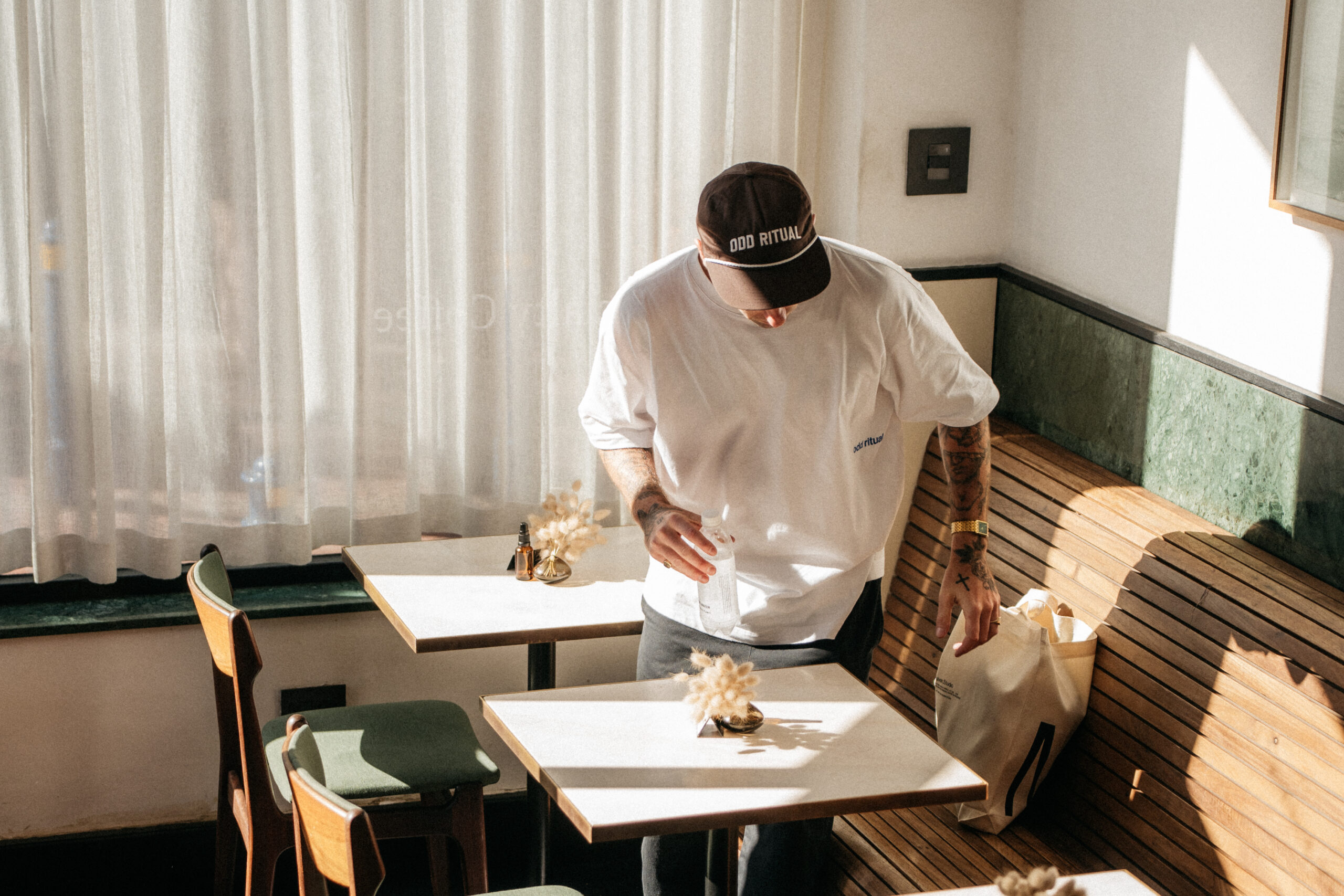
Yes exactly. I grew up skating and surfing, so golf was always this weird, stiff sport you had to dress up for. After COVID, I started playing more and realised how creative the game actually is. But the clothing? I felt like a frat boy every time I stepped onto the course. It didn’t feel like me—it didn’t feel like any of the things I grew up around culturally.
Internationally, golf culture is shifting. There are boutique brands, YouTube golfers, and this younger, more expressive crowd coming into the game. People are wearing clothes that reflect their personalities, their backgrounds, their subcultures. But in South Africa, nothing existed that represented the world I came from—the art, the patterns, the skate and surf influences, the colour of the streets we grew up on.
I kept looking for something that merged those two worlds: the discipline and precision of golf with the creativity and looseness of street culture. No one was making the clothes I wanted to wear, so I started making them.
Odd Ritual became a way to bring South African design language onto the course—not in a cheesy or forced way, but in a way that feels authentic to who we are. It’s the stuff Lané and I talk about all the time: the nuance, the cultural overlap, the small details that make something feel considered.
She helps me look at the broader picture of the brand, how everything ties together. For me, it’s still about craft—obsessing over cuts, fabrics, the tiniest details—but Odd Ritual is also about expression, about giving golfers in South Africa something that feels rooted in home.
But the brand really started from that simple place: I couldn’t find anything I wanted to wear, so I made it. And the more I made, the more I realised how much room there is to push golf culture forward in a way that feels uniquely South African.
Bryan: I also heard you do a swim from Robben Island to Blouberg for charity. Can you tell us a bit about that?
Tim Evans:
Every year we swim from Robben Island to Blouberg—it’s 7.4 km in very cold, very real ocean. But the reason behind it is what matters.
It’s called the GrootSwem, and its mission is to raise money for Startwell, an NGO that developed a porridge designed to combat childhood stunting. For every 900 rand raised, one child gets fed nutritionally for an entire year. This year we raised just over a million rand.
It’s one of those things where a small individual effort has a massive effect on kids’ futures. And it feels good to do something physical that ties back into South Africa’s bigger story—giving children the same starting block many of us were lucky enough to have.
Stefan: What’s one piece of advice you’d give young entrepreneurs or creatives?
Tim Evans:
Just flippen do it. Seriously. If you want something, start. Don’t sit in limbo wishing you’d done more while clinging to the safe option.
People want shortcuts—overnight success, AI hacks, quick wins. But the truth is: if you believe in something, you’ve got to work like hell for it. Consistently. For years.
And stop pivoting every six months. If you’re convicted in an idea, commit long enough to see it through.
Stefan: You’ve worked with clients in Europe, the UK, and now increasingly in the U.S. What do you think makes South Africa such a compelling creative destination?
Tim Evans:
Work ethic is a big one. We don’t complain—we get on with it. Every international client we’ve worked with says the same thing: “You guys are incredible to work with.”
But beyond that, South Africa has this cultural overlap you don’t find elsewhere. We all grew up surrounded by radically different people, styles, histories, tensions, and influences. That gives us perspective, and it shapes how we see the world and how we solve problems.
Tim’s story is peculiar in the best possible way. He never set out to be an entrepreneur, yet he built two companies. He never chased leadership, yet he became the centre of a studio that people now build their livelihoods around. What makes that so compelling is how unforced it all is—none of it born from grand ambition or a five‑year plan, but from following the work, trusting his instincts, and caring enough to hold a standard.
His path is proof that great things often don’t come from elaborate strategies or perfect timing, but from pure intention, conviction, and the willingness to keep showing up even when the road ahead isn’t clear.
Every week, The GBJ editorial team sits down with some of South Africa’s best. With a tenacity and spirit that can create success out of nothing more than a glimmer of hope, we believe South African businesses deserve a platform to tell their stories.
Born from WDR Aspen, The GBJ wants to ask you: how are you telling your story? Reach out and let us help you with your voice.