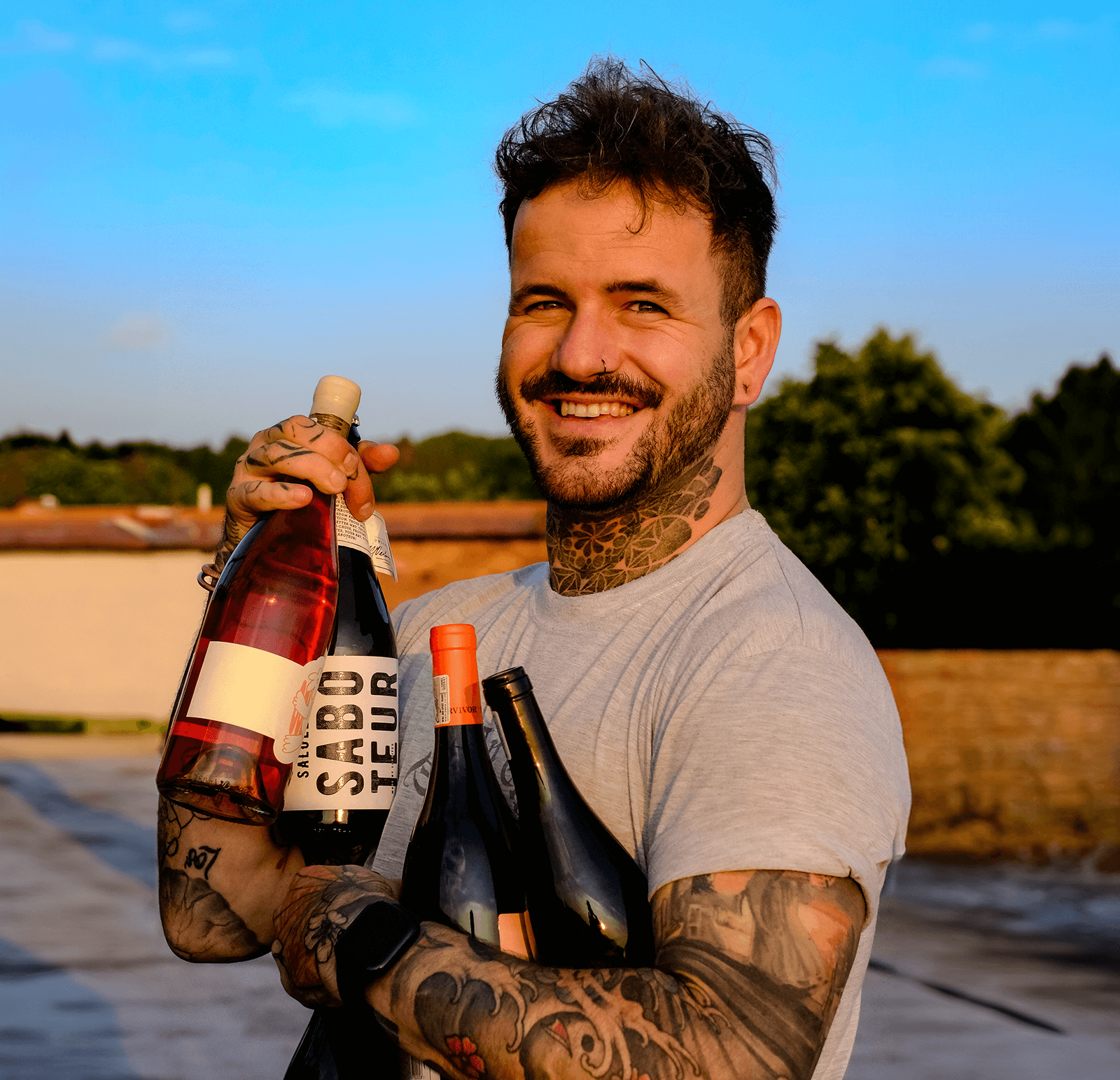
Bryan Welker, Stefan le Roux, and Jessica Rosslee sat down with Julian to discuss his journey from the bushveld to the world’s best bars and how he built a reputation that has reached Forbes magazine and almost every corner of the bartending world.
There’s a particular rhythm to the way Julian Short speaks about life, a cadence you’d expect from someone who’s spent years perfecting the flow of a cocktail pour. Before he became the creative mind behind Johannesburg’s iconic Sin+Tax, Julian grew up in the bush, listening to stories told on cassette tapes during long road trips and watching his parents welcome guests with effortless warmth.
Today, the bar he and his partner Evert De Jong took over in 2020 regularly ranks among the World’s 50 Best, and their beverage company is expanding across Africa. His story is a testament to what resilience—and good taste—can create under pressure.
The Good Business Journal: You grew up on a game lodge in Mpumalanga—that’s a world away from the cocktail scene. What was that like?
I grew up surrounded by hospitality before I even knew what that word meant. My parents ran a game lodge in the ’80s and ’90s, and it was one of those places where guests were like family. I spent most of my early childhood in the back of house—kitchens, workshops, staff quarters—not the guest area.
Childhood memories are often vague, you know, but I vividly remember my parents had this switch—the second a guest walked in, they became these hosts who oozed hospitality. That taught me a lot. I think it’s where I learned that service isn’t servitude; it’s pride. It’s an energy you give to people.
Eventually, my parents took a job in the city with a hospitality group, so we packed up and moved to Johannesburg.
GBJ: What do you remember about those long drives once you’d moved to the city?
The city feels like another planet compared to the bush. My parents were always on the road, managing different lodges. We’d spend hours driving to game farms listening to audiobooks. I was too young to remember the game farms by name but I could tell which reserve we were heading to just by how long we’d been on the road. Those trips gave me patience, imagination, and a love for storytelling.
GBJ: How would you describe your secondary school career?
I was a terrible student. ADHD, couldn’t sit still, on Ritalin. School didn’t suit me. Eventually, I was sent to boarding school in KwaZulu-Natal. It helped, but I still didn’t know what I wanted to do when I left.
GBJ: What did you get up to after you left?
So I studied music and sound engineering, worked in studios, toured with bands. I loved sound but it felt like I couldn’t quite sink my teeth into it in a way that would lead to a career. I just felt lost. Then my girlfriend at the time told me to get a bar job—literally just to have structure. That one decision changed everything.
GBJ: What was that first bar job like?
It was a wake-up call. I started pouring pints and wiping counters, and for the first time, I felt grounded. There was discipline to it, rhythm, and people. It kept me out of trouble.
One night a guy ordered a Negroni. I had no idea what that was. I quickly Googled it, called a mate for the recipe, made it—and completely messed it up. The guy laughed and said, “You’ve never made that before, have you?” Then he told me to come work for him. That guy was Gareth Wainwright, and he became my mentor.
That’s when it clicked. I saw how passionate bartenders could be—the craftsmanship, the performance, the creativity. And for the first time, I thought, I can do this.
GBJ: You mentioned ADHD earlier. Do you think it played a role in your creativity?
Definitely. It’s a superpower once you learn how to use it. I need movement and physicality to focus—working with my hands, being in flow. That’s what bartending is for me: a physical meditation.
The key is creating an environment where your brain can lock in. That’s when the magic happens—when you’re completely immersed in the craft.
GBJ: Tell us about your first big break, the competition in Mexico.
That was wild. I entered my first cocktail competition in Gareth’s place because he couldn’t. I won Johannesburg, then Cape Town, and they sent me to Mexico. It was my first time leaving South Africa. I placed fourth or fifth, but that didn’t matter.
I remember calling my mum from Mexico and saying, “This is it. This is what I’m going to do forever.” She just said, “We knew we’d get this call one day and we fully support you.” That’s all I needed. From then on, I went all in—competitions in Cuba, Sweden, France—and I won eight titles in three years.
GBJ: How did Sin+Tax come to life?
After all that travelling, a group of investors approached me about opening a bar. At first, I said no. Then I looked at the space and thought, Actually, I can do this.
We opened Sin+Tax in 2016—a 40-seat speakeasy hidden behind a pizza restaurant. The name’s a play on South Africa’s “sin tax” for alcohol and cigarettes. It felt right. I wanted every detail to matter: the counter height, the lighting, the smell, the soundtrack.
We were doing something totally new for Johannesburg—a serious cocktail bar with professional bartenders who understood the craft. We capped the room at forty people. When we were full, we closed the doors. That exclusivity freaked people out, but it also built the brand.
GBJ: Did you ever wrestle with imposter syndrome as Sin+Tax started gaining traction?
In the beginning, absolutely. I felt like I was making it up as I went along—designing a space and a style that didn’t really exist here yet. There was pride, but also fear. Every night I’d think, What if this doesn’t work? What if I’m not as good as people think? That feeling still creeps in sometimes, but I’ve learned to use it. It pushes me to keep improving, to keep refining. That tension between confidence and doubt—that’s where growth happens.
GBJ: How much were you working during those early years?
Insane hours. I was in the bar from 11 a.m. until 3 a.m., five days a week, for four years. I made every mistake you can think of but that was my education. You can’t fake the graft. It’s how you make your own luck in business. Every long night teaches you something you can’t learn in a book.
GBJ: What was your lowest point in your career?
It was that second time in Mexico—the big one, like a global MasterChef for bartenders. I’d entered before and always come close, sixth or third within South Africa, but that final year I won locally and earned the chance to represent the country.
I went over with good energy, but when the brief landed it was huge—the kind of thing that psychs you out if you let it. In hindsight, I prepared the wrong way. I overthought it. I built elaborate stories that had nothing to do with what the challenge was really about. The competition itself is meant to be about hospitality—about setting an atmosphere, creating a mood, being hospitable—and I’d stripped all that out by trying too hard.
The room was full of lights and cameras, competitors from around the world, and the pressure to win glory for your country.
When I didn’t make the top ten, and then saw I hadn’t even cracked the top thirty out of fifty, I was gutted. I felt humiliated. I’d worked so hard, carried all that pressure, and completely lost the plot of what I was there to do.

GBJ: Would you be where you are today without that humiliation?
No ways. That loss was the lesson. It was my chance to make every mistake I needed to—I earned the right to make them on a global stage. In hindsight it taught me that what I did on stage wasn’t hospitality. Storytelling and technique are part of it, but they aren’t the focus.
Even the drink is secondary. It’s about who you are as a bartender, as a person in front of another person, walking them into a space and creating an atmosphere. That realisation rewired me. I came back and thought, I know exactly what I’m here to do, and I focused on experience over performance.
GBJ: I believe you got a chance to redeem yourself a few months later in France?
Yes I did. I got invited to a cocktail competition in France. This time I walked in with a completely different mindset—I was like, I don’t give a damn. I knew the drink was great, the story was good, and I was just there to have a good time. That energy changed everything—I ended up winning the whole thing.
The prize money was massive for me at the time, and it became the seed that changed everything. I bought a fridge, I bought a suit, and then I used the rest to buy my first shares in Sin+Tax alongside my best friend Evert.
GBJ: How did ownership change the way you interfaced with your role at Sin+Tax?
I realised I couldn’t keep working in the business—I had to start working on it. That shift was hard. Bartending had been my identity for a decade. But when I finally trusted my team, everything changed.
Now we employ eighteen people. My head chef started as a dishwasher. My head bartender’s winning competitions. Seeing people grow—that’s better than any award.
GBJ: What’s the energy at Sin+Tax like now?
It’s electric. We’ve got our inside speakeasy, a courtyard with live jazz every Thursday, and a kitchen that punches way above its weight. It feels like family—and after nine years, we’re still evolving.
GBJ: I believe you and Evert have another venture together. Can you tell us more about that?
Yeah, we started a company called Just Short. Ev and I were already experimenting with ingredients, and we realised there was a gap in the market for high-quality, non-alcoholic cocktail products made with the same craft and precision we use at the bar. So we built it from scratch.
Today, Just Short supplies hotels and bars across Africa. It’s our way of scaling hospitality—taking what we’ve learned behind the counter and bottling it, literally. Sin+Tax will always be home, but Just Short lets us share that standard of experience on a bigger stage.
GBJ: Julian, there’s so much to learn from your story but what would you say to a young bartender with big dreams?
Trust your gut. Learn the fundamentals. Respect the business—it’s not a playground. You can be creative all you want, but you have to make the numbers work.
And remember: your guests won’t remember every drink, but they’ll remember how you made them feel. That’s hospitality.
GBJ: And finally, if you had to sell South Africa to a global investor in one line—what’s our edge?
Our attitude. The way we face things. South Africans have this mix of resilience and warmth—it’s like a built-in hospitality gene.
I think South Africa suffers from collective imposter syndrome. We seem to think that we are so far behind in a lot of ways but I’ve travelled the world, and I can tell you, we’re not behind. We’re just different—and the world’s starting to notice.
From the quiet bushveld roads of his childhood to the bright lights of global stages, Julian’s story is proof that real mastery doesn’t come from avoiding failure but from embracing it, learning from it, and building something better. Through Sin+Tax and Just Short, he and co-owner Evert De Jong have redefined South African hospitality, showing that excellence can thrive anywhere when passion and purpose are poured into every glass.
Every week, The GBJ editorial team sits down with some of South Africa’s best. With a tenacity and spirit that can create success out of nothing more than a glimmer of hope, we believe South African businesses deserve a platform to tell their stories.
Born from WDR Aspen, The GBJ wants to ask you: how are you telling your story? Reach out and let us help you with your voice.